Showing posts with label Exhibits. Show all posts

Tuesday, October 25, 2011

Stories of Food

By: Sue deBruijn, Visitor Services and Retail Manager

As we continue our focus on foods of New York State to coincide with the Good Eats! New York’s Fabulous Foods exhibit, The Farmers’ Museum Store has become a fabulous resource for cookbooks.


There are so many to choose from, but book buyer Donna Williams has been very selective, procuring several relating to the exhibit; such as Hog Island – Oysters Lovers Cookbook, Ice Cream, the delicious History, Jell-O Classic Recipes.

Most notably is one that we stumbled upon recently, and we’re proud to say that we are one of only 25 stores within New York State that is carrying it so far!  The title is Taste and Tales of New York, by Ann Pieroway.  At first sight we knew it was a perfect fit for the Store.  It is unique in several ways.  Not only does it have 200+ incredible recipes, many of which come from New York State landmarks such as Tavern On The Green and The Otesaga Resort, but it’s also full of delightful facts about New York State.


One of the first things that struck me as I leafed through the cookbook was the thoughtful dedication; “To the brave men, women and children who lost their lives on September 11, 2011, and to the first responders who sacrificed their lives to save others.  Always Remember!”  Also, a portion of the profits from the cookbook are dedicated to selected projects throughout New York State.

From there you turn the page to find interesting short stories and illustrations regarding historical facts and places of New York State.  The Appetizers and Beverage section begins with an illustration of Henry Hudson’s ship, “Half Moon.”  Soups and Salad is adorned by none other than Lady Liberty, Entrees has the Erie Canal in 1825, and so on.

The stories keep you turning pages.  From a half page story about Henry Hudson, to the Search for Mia, an escaped Egyptian Cobra from the Bronx Zoo in 2011, they cover all spectrums.  And be sure not to miss those which relate to The Farmers’ Museum and the Fenimore Art Museum as well!

Many of the foods highlighted in the Good Eats! exhibit have their history described in the pages of this delightful cookbook as well as related recipes, such as Egg Cream for One, Thousand Island Dressing, and Buffalo Chicken Wings.

So far my favorite recipe is Tapenade Dip on page 18, although I leave out the anchovies!

This is truly the quintessential New York State cookbook, and we are delighted to offer autographed copies in The Farmers' Museum Store. It's coming son to our web store as well.

Monday, July 11, 2011

The Legacy of Family Recipes


By: Sue deBruijn, Visitor Services and Retail Manager


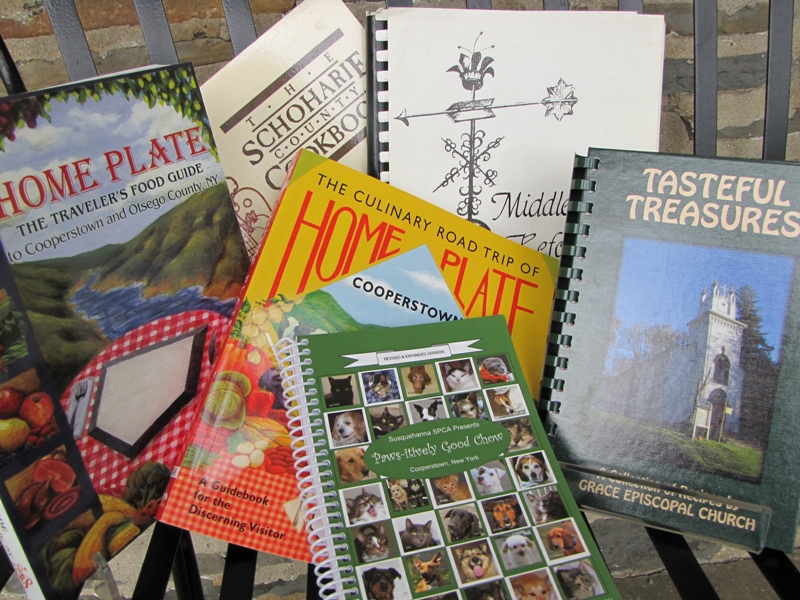
Churches, Ladies Auxiliaries, Fire Halls, Animal Shelters: these are just a few of the multitude of charitable organizations who produce cookbooks chock full of recipes from friends and neighbors.  These cookbooks come in all shapes and sizes, handwritten or typed, bound or stapled.  They are a collection of tried and true recipes compiled by hard working volunteers, and there are legacies of love inside.

To go along with the New York’s Good Eats! exhibit, we decided to carry some of these locally produced cookbooks in The Farmers’ Museum store.  I put out an All Points Bulletin looking for organizations that may have some for sale.  Immediately I received several responses, but only two with cookbooks that we could procure – The Grace Episcopal Church of Cherry Valley and Susquehanna Animal Shelter.  Everyone else had a story they wanted to share about their own cherished local cookbook.  One friend responded that his favorite included a recipe for Turtle Soup.  It began with “Step 1 – Go down to the crick and catch a turtle.”  One of my personal favorites was in the “Men’s Recipes” section where I found a recipe submitted by my Uncle Rudy.  It read, “Sloughter Pot Pie – Ingredients:  1 chicken stolen from a hen house, plucked and cleaned.”

This prompted me to pull out my favorite – the Middleburgh Reformed Church Cookbook.  As I leafed through the yellowing pages, I found recipes from my grandmother, my mother and my aunts, all of whom are no longer with us, but left a legacy behind in their recipes.  I felt myself drawn closer to these women as I read their recipes and pictured them, wearing homemade aprons, lovingly making these meals for our family.

The cookbook also had a surprise for me.  In what I consider the best section, Desserts, I came across Hot Fudge Sauce by Sue Grogan.  Wait, that used to be me!  In my family, the recipe was more commonly referred to as Soozers Sooper Sauce.  I had completely forgotten about the recipe, which had actually been my mother’s.  I always helped her make it so that I could lick the spoon and dip my finger in the fudge sauce while it was still warm.  Graciously, my mother pretended that it was my own special recipe and must have submitted it to the cookbook 30 years ago when it was first printed.

A few months after finding that recipe again, my five sisters and I were gathering for our annual Sisters’ Weekend.  To their surprise, each of them received a jar of homemade Soozers Sooper Sauce, and we spent hours reminiscing about cooking with Mom.  All thanks to that beautiful old cookbook.

Thursday, April 23, 2009

Sneak Preview: Dr. Jackson's Office

By: Erin Crissman, Curator
Ironically, I’ve been fighting off a cold and working on the exhibition plan for the newly restored Dr. Jackson’s office this week. Here are some updates on this project, scheduled to open on July 4th weekend. Interior restoration is almost complete. The plaster has been repaired and new paint applied. This bold ochre color is a historically accurate hue from one of my favorite publications--Historic Colors of America--a paint chart developed by Historic New England. The floors still need painting. The original floor boards were quite worn in some areas and needed to be patched. The paint will help us to protect the floors for future generations. The space will be used much differently for this new exhibition. Previous exhibitions in this building showed each small room as part of Dr. Jackson’s work space. Today, we know that only the front part of the office was available in the 1840s. The back addition was constructed by Dr. Drake, who took over the building and practice when Dr. Jackson died. This time, the front part of the building will be a sparsely furnished office like Dr. Jackson would have used; the back will feature an exhibition highlighting some of The Farmers’ Museum’s medical collections. When we develop exhibitions, there are always changes from the original plan. Come by in July to find out if this drawing (not to scale) resembles the final product!

Tuesday, April 21, 2009

Law Office Silhouettes

By: Kajsa Sabatke, Interpretive Projects Coordinator
Have you noticed the silhouettes in the law office? As a graduate student, I worked with a group of my classmates from the Cooperstown Graduate Program to develop this exhibit. To create exhibit panels in the shapes of people, we used historic photographs that we found through the Library of Congress. We chose these images because they represented a variety of people who lived in the 1850s (the time of the Dred Scott decision) and because their subjects had silhouette shapes that could fit the text and images we added to the panels. Some people are famous – like Dred and Harriet Scott and William Sidney Mount – and some are not. In fact, my favorite silhouette comes from the only person not identified on the LOC website. He probably worked in a foundry since he is photographed holding a floor rammer, a tool used for packing sand around a pattern to create the mold for a metal casting. After creating his silhouette from the photo (he’s the one on the left), we began to refer to him simply as Ears. The silhouette captures many details: the tilt of his hat, the wrinkles on his pants, his rolled sleeves, his straight posture, and the shape of his ears. I’m not sure why this silhouette is my favorite, but it catches my eye whenever I visit the law office.
Top: Occupational portrait of two men, standing full length holding floor rammers, foundry tools used for packing sand against molds. ca. 1850. Libraryof Congress, Prints and Photographs Division, LC-USZC4-11324
Blog Widget by LinkWithin