Showing posts with label Interns. Show all posts

Thursday, August 9, 2012

Meet the Sheep: Bonnie Jane and Daisy

By: Allison Shelly, Farm Programs Intern
There is a tale from a long time ago that tells of a great naval battle. Homelands are to be protected and invaders to be pushed back. Ships crash against waves and fail to see the rocky shore line, breaking into pieces. The surviving crew swim desperately to shore avoiding the dangerous rocks, finally getting precious land under their legs. They struggle onto shore wet and bedraggled to a new life and a new home, a home that their descendants would grow up in and adapt to.

Who would think that this tale of great ships and shipwrecks would have anything to do with The Farmers’ Museum in the middle of beautiful New York, miles from the dangerous seas, but it does. For it was by the shores of Great Britain that the great Spanish Armada sailed up the English Channel to attack England, and it was there that the English successfully turned them away. But what of those wet crew members floundering onto shore? Why they were sheep of course! The might even be great great great ancestors of our very own Cheviot sheep, Daisy and Bonnie Jane.
Our two full grown Cheviot sheep, Bonnie Jane (left) and Daisy (right) relax in the field. 
There has long been speculation that Cheviot sheep could have been descendants of the sheep that may have escaped from ships in the Spanish Armada. The American Cheviot Sheep Society includes a brief history of the breed in one of their Flock books and they mention such a story. But they are not completely convinced, saying, “This tale, however, has also been given in explanation of the origin of yet other breeds, so that coming from the sea, we may accept it as somewhat fishy in flavor and quality.” Instead, they feel that the Cheviot’s had been living in the Cheviot Hills between England and Scotland for a long time and were originally called “long sheep”. Slowly the name changed to Cheviot sheep, after the Cheviot Hills where they lived.

Whether or not the origins of the Cheviot breed began with heroic sheep swimming ashore or by humbler means, the breed’s introduction to the United States is less mysterious. They arrived later than the Tunis, around 1838, and were imported right into the state of New York by Robert Young of Delaware County. More of the breed entered the United States in 1842, brought by George Lowe, and came to live not far from here in Hartwick. The breed spread into the southern counties of New York, especially our very own Otsego County.

Like the Tunis sheep, Cheviots are listed as a meat breed by the American Sheep Industry Association, but this does not mean that their wool is useless. In fact the historic American Cheviot Sheep Society found great pride in Cheviot wool, claiming that it has fewer oils in it than other sheep and, when washed clean, it is the whitest wool on any sheep. In fact even in the field you can identify the Cheviots by their very white wool.
A close up of Daisy (front left) and Bonnie Jane (front right), with our  Tunis sheep in the background.
Next time you visit the Lippitt Farm, see if you can tell the difference between our sheep. The Tunis has red or light brown legs and face with cream colored wool. The Cheviot has white wool and a white face with no wool on the legs. Any sheep that does not look like these two must be the sheep for the next post, the Delaine- Merinos! So come stop by; Bonnie Jane, Daisy and their lambs always love visitors! 

Monday, August 6, 2012

What Did We Do Before Wonder Bread? - Part 2

By: Adrienna Maxwell, Farm Programs Intern

Back in the 1840s, New York State was one of the top producers of wheat in the country.

To first put things into perspective, it is helpful to look at wheat consumption on an individual level. The average family size at this time was six people. It is difficult to know exactly how much bread individuals consumed. In 1875, in calculating how much flour would need to be traded to Sweden, the U.S. Department of State calculated that a person required about .67 lbs of bread per day. Using that number, the average family of six in the 1840s would consume 4 lbs of bread daily, and 1460 lbs (or about 30 bushels) in a year! In 1845 the average acre in Otsego County (which includes Cooperstown, NY) produced 13 bushels of wheat. That means that families would have to grow just over 2.3 acres of wheat every year to feed just one family. That’s not even accounting for saving seed for the following year or selling seed to millers for profit! Thanks to Jenna Peterson, former Farm Programs Intern, for crunching these numbers.
We have a small demonstration plot of wheat behind the hop house here on the Lippitt Farmstead. It was planted by hand, and then furrowed in by our draft horse, Zeb, and the farmers. This plot is only about 1/18th of an acre, which means a family of six would need to grow over 41 times this amount of wheat!
So how did they harvest all this wheat and get it from field to table in the mid 19th century?

Farmers had about ten days at the end of the wheat growing season to harvest the grain before it would separate from the stalk and fall to the ground. They would use a scythe or a grain cradle to cut the stalks and then they would bundle the stalks together into sheaves to take to the barn, where the bundles would be spread out on the threshing floor. Up through the 1800s, threshing (the separation of wheat kernel from stalk and chaff) was done by using a flail to beat the stalks. This allows the grain to separate from the stalks. The winnowing basket would be used to toss the grain into the air, at which point the cross breeze coming through the correctly situated barn would blow the chaff away and leave the kernels. However, with this method some dirt and unwanted debris would still remain and have to be picked out by hand. Another option for threshing grain at this time was to have a team of oxen trample the stalks on the threshing floor, and then use the winnowing basket. Either way, it was hard, time-consuming work.

In this picture, the flail is on the left and the winnowing basket is on the right. These items are hanging in Brooks Barn at The Farmers’ Museum and are used for demonstrations, especially during Harvest Festival (which will be September 15th and 16th in 2012). 
The fanning mill was invented to replace the winnowing basket, sometime between the late 1700s and the early 1800s. This separated the grain from the chaff much more easily than it could be done by hand, and as technology progressed the fanning mill had more sieves added to it and became horse powered and such to make the process even faster.
A view of our fanning mill from the end where the grain and chaff is separated. The grain falls through and the chaff is blown away by the fan blades when the machine is being cranked. 
A full side view of our fanning mill, with a glimpse of the fan blades. This is also resting in Brooks Barn, so stop by and take a look! 
Most of the grain produced in this state in the 1840s was concentrated in the Genesee Valley, as mentioned in the previous post I wrote on this topic; it was then ground into flour in large mills in Rochester and shipped eastward along the Erie Canal, which had opened by 1825.

Wheat was a major product in New York State from the time of early settlement through the creation of the Erie Canal and westward crawling railroads. The Genesee Valley was once known as the “Granary of the Country” and Rochester as “Flour City”. So what happened? Why is wheat no longer a major crop of New York State?

As with the movement of most crops, it was a combination of factors. By the end of the 1700s, farmers were already battling a fungal disease called black stem-rust which was prevalent in any place that wheat had long been cultivated. By 1830 the Hessian fly and the midge fly had both wrought severe destruction on the eastern part of the state’s wheat crop, and production had all but ceased to exist in those regions until about a decade later, when the farmers finally figured out how to fight off these pests. And with the creation of the Erie Canal, it became much easier for farmers from the Midwest to grow wheat and ship flour east.

By the end of 1860, New York and Pennsylvania had fallen from the top production spots, and were replaced by Ohio, Indiana, Illinois and Wisconsin. The New York State growers held on for awhile because of New York City’s ever increasing demand for grains, but eventually almost all wheat production in the state came to an end. In 2009, New York State was 32nd in the country for wheat production, though there has been some recent movement to grow organic wheat in New York. If you are interested in learning more about that, I suggest plugging “Northeast Organic Wheat Project” into your Google search bar. You might just be surprised!

Thursday, August 2, 2012

Meet the Sheep: Louise and Lillian

By: Allison Shelly, Farm Programs Intern
Over the past couple of months I have had the opportuity to be a Farm Programs Intern, and one of my favorite things to do is watch our sheep on the farm. While on hot days they lay in the shade keeping cool, on milder days you’ll find them lazily grazing, the lambs jumping and playing. Look closely and you might notice that the sheep in our flock don’t all look the same. In fact, there are three different breeds of sheep in our flock, and each has very distinctive features as well as a unique history.

The one breed that is perhaps the most obviously different from the others is the Tunis sheep. These sheep have reddish colored heads and legs with cream or white colored wool. When the lambs are young they have a reddish tinge all over, but as they grow their wool changes to the same creamy white color of their mothers. As with many animal breeds the Tunis sheep did not originate in the United States. They were transported from their home country of Tunisia in North Africa when the Consul to Tunisia sent a number of Tunis sheep (also called Barbary or Mountain Tunis sheep)  to the United States in 1799. It was a tough journey for the sheep, and only one pair survived. They were sent to Judge Richard Peters, who resided near Philadelphia. He soon became an advocate for these sheep, and the breed spread quickly through Pennsylvania, and up into New York, though the majority of the breed spread south down to South Carolina.
Lillian (on the right) and Louise (on the left) are the two Tunis sheep on our farmstead. In the middle is Louise's lamb, born this spring. This ewe lamb is a Tunis-Cheviot mix. Learn more about Cheviot's in the next sheep post!
It soon became apparent that the Tunis sheep were an excellent and  well-rounded breed, providing top quality mutton as well as decent wool. Tunis mutton dominated the Philadelphia market, and while Tunis wool was not as high quality as Merino wool, it often used to make blankets. Even Thomas Jefferson had a few Tunis imported and bred them for the quality of the meat as well as for the wool.

Tunis sheep are very hardy and can handle both hot and cold weather relatively well. This was one reason that the Tunis became one of the more popular sheep breeds to raise in southern states. During the Civil War the breed was nearly wiped out, eaten by hungry soliders on both sides. If it wasn’t for the actions of Maynard Spigener from South Carolina the breed may not have survived. He hid the last flock of Tunis sheep on his property by the Congoree River and managed to preserve the breed! Even today the Tunis are listed in the watch list of the American Livestock Breeds Conservancy, meaning that less than 2,500 Tunis sheep are registered in the United States. After the Civil War the breed was mostly found in the northern states, though recently the breed has been making a comeback in the southern states as well.
A close up of Louise and her ewe lamb. 
While the Tunis sheep may not have been one of the most popular sheep breeds to have an upstate New York farm in the 1840’s, it was one of the options a farmer would have had. This is why you can come out this summer to meet our two lovely Tunis ewes, Louise and Lillian as well as their quickly growing lambs! Maybe they’ll wander up to the fence so you can see, and appreciate this historic sheep breed.

Stay tuned for more information about the other sheep in our flock!    

Monday, July 23, 2012

What Did We Do Before Wonder Bread? - Part 1

By: Adrienna Maxwell, Farm Programs Intern
Here at The Farmers’ Museum, we recently finished up our busy school programs season. Museum Quest, our school program during May and June, is an adventure of sorts with a variety of learning stations set up throughout the Fenimore Art Museum and The Farmers’ Museum. Topics range from trading and bartering goods to making small bean necklaces to take home. I ran the Farm Chores station for most of May and June and you would be amazed at how many of the children started shouting and cheering when asked if they want to be put to work like they would have been in the 1840s! The activity at this station varied from day to day and week to week, depending on what we needed done around the farmstead. On our busiest June days we had the children grinding wheat kernels into flour.
The line went right out the wood shed door of Lippitt Farmhouse! Look at all of our eager workers!
If we had not wanted to grind our flour by hand, other options would have been available to us in the 1840s. By the 1830s, Otsego County alone had 70 gristmills where local farmers could send their grain to be milled. However, most of the flour used in the 1840s was purchased from the local stores, which would have imported their flour from none other than “Flour City” (Rochester, NY) by sending ox-cart men to meet barges at their stops along the Erie Canal as they passed through on their way to Albany.
I held the mechanical corn grinder in place as all of the kids took turns trying their hand at grinding. It’s harder than it looks! This was our way of simulating the process that steam or water-powered mills of the time would have used to grind wheat into flour.
It is important to mention that there are differences between the type of flour we are making in these pictures and the kind of flour that goes into bread that you might purchase from a grocery store today. The recipe for making bread flour began to change sometime in the early 1800s, primarily due to a cultural shift. Flour made from the whole kernel was used primarily by those of the lower classes who could not afford something better; oftentimes it was mixed in with other grain such as rye or cornmeal. The more affluent preferred more refined “whiter” flour for their baking needs, and there were varying degrees of fineness to select from. To make the flour white it was bolted, a process that separated the bran from the rest of the flour and would produce a whiter flour that would also keep much longer than flour with bran left in it. During the 1840s, millers were still unable to separate all of the germ from the endosperm, but over time the technology of mills improved to the point where this was possible as well.
It took over 700 children to grind up enough flour for just a couple of loaves of bread, which our Lippitt House staff baked the following Saturday on the designated weekly baking day. We think we should have worked the students harder to get more flour – the bread was delicious!
Today, we make white flour from only the endosperm of the wheat kernel, which is the white starchy part with the lowest level of nutrition in the whole kernel. The other two parts of the kernel, the germ and the bran, are very nutrient rich and are often neglected in modern day production of flour. We actually feed those parts of the kernel to our livestock to meet their nutritional needs! Even what we consider to be whole wheat bread today is made of flour with only a small amount of bran and germ put back into the flour after it has been processed.

Although social implications played a significant role in this switch, part of the reason that today’s flour manufacturers only use the endosperm could be because the released oils and nutrients of the processed bran and the germ can cause the flour to go bad in less than a week if not refrigerated or frozen.

Modern day flours and breads compensate for the decrease in nutritional value by enrichment with added vitamins and minerals. It would appear that we have come full circle in our wheat and flour production, or at least attempted to, and in quite a strange way!

Come back later this month for more food for thought and read part two, which will focus on the historical production of wheat in New York State.


Tuesday, August 16, 2011

What I Did For My Summer Vacation

By: Jenna Peterson, School and Farm Programs Intern
Friday, August 12th was my last day as an intern for The Farmers’ Museum. Working as the School and Farm Programs Intern this summer was a great chance to really test out my interest in museum education. It also gave me the chance to put into practice all of the theory and ideas I learned in my museum studies graduate program.

I had some amazing opportunities; at the beginning of the summer, I dove right into planning the week-long experience for 5-7 year olds, Down on the Farm. I now know a lot more about what it takes to run a summer camp type program, and just how much communication needs to happen between the different departments to make sure such a program goes off without a hitch.
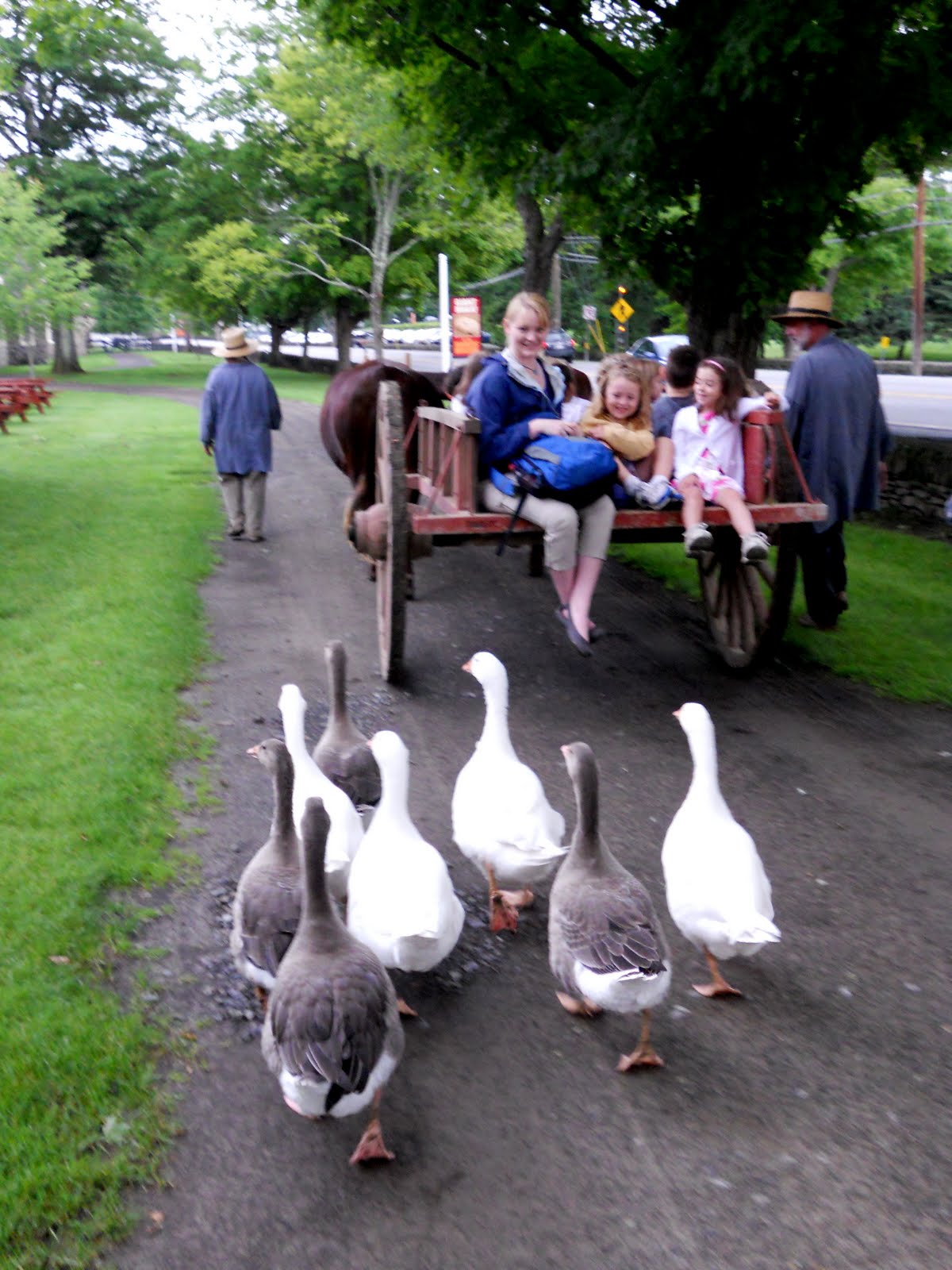
The geese following our wagon ride during Down on the Farm
For my next big project, I got to write background and structure for several of the Lippitt Farm Walk and Talk lessons. Now the farmer staff can give extra lessons on corn, poultry, and some of the odd crops we grow like tobacco and mangel-wurzels.

The last major project I tackled this summer was rewriting one of our popular school tours, Ox-Cart Man, to align with the new Common Core Standards that New York adopted. These standards are more focused on skills rather than facts, and the new lesson will help teachers and students make the most out of their visit. Although I am fairly certain I can now recite the curriculum in my sleep, I am very pleased with the finished product. I am glad I’ll be around this fall to see the Museum Teachers take it for a test drive.
One last visit to the Children's Barnyard
This summer has been an amazing experience, both for the work I got to do as well as for the camaraderie. If you haven’t yet met the museum’s staff, you should make a point to do so. They are all amazing people, and those that I got the chance to work alongside helped make this summer very special. I want to make sure to thank Mary Kuhn, who tolerated me stealing her desk and computer on a near daily basis throughout the summer. I also had the chance to work next to the amazing Public Programs Intern, Meredith, and I wish her all the best as she travels to Russia this semester.

Finally, I want to thank Keelin Purcell, the Manager of School and Farm Programs. She had only been employed by the museum for a few short weeks when she had an intern dropped into her lap. I have had internships in the past where I spent the whole time answering phones and making copies, but Keelin made sure I had a rewarding experience throughout the summer.

If you are interested in interning with either the Farmers’ Museum or at the Fenimore Art Museum, make sure to check their websites for upcoming information on potential internships. 

Sunday, August 7, 2011

Lippitt Farm Walk and Talk Lessons

by: Jenna Peterson, School and Farm Programs Intern
Part of my internship this summer has been gathering information on different agricultural topics, and using it to write interpretive lessons to be delivered by our farm staff. The farmers do an amazing job of talking about a variety of farm subjects, and I was able to provide them with more primary source material to work with, including census data, journal articles, and seed catalogs all from the middle of the 19th Century.

One of the reasons to have a goose on the farm is to collect their down feathers for use in pillows. 
There are four different talks that can be given based on these lessons; corn, poultry, crops, and the interpretive field garden. The corn talk focuses on changes in technology and farming practices, and how that impacted corn growers in the 1840’s and today. While I don’t think I was assigned to research corn because I am originally from Iowa, it probably didn’t hurt! The poultry talk focuses on the different varieties of poultry farmers would have had, including chickens, ducks, geese, turkeys, and even pigeons. We have everything but the pigeons here at the museum, so it is a great chance to see how they would have been raised. For the crop talk, the focus is more on the unexpected crops farmers grew alongside those we think of today. This means looking at things like buckwheat, barley, hops, tobacco, and my personal favorite, mangel wurzels. Be sure to check out this post from Farmer Marianne about mangel wurzels if you are interested in learning more!

Mangel wurzels, a type of beet, were commonly used as animal feed.
The final talk is not actually given by our farmers, but is instead led by myself or my supervisor. We take visitors through the interpretive field garden planted in front of the Lippitt House, and discuss the history of these field crops, as well as the different parts of plants that we eat. Did you know potatoes aren’t actually the root of the plant? Come listen to our talk and I’ll tell you all about it!

Corn was planted in a checkerboard fashion with squash and beans, modeled after the Native American Three Sister's Gardens.
These talks will take place at 2:00pm every day through Labor Day. They leave from the steps of the Hop House, and are open to all visitors. If you happen to be near the museum, stop by and learn more about farming in 1845. 

Wednesday, July 6, 2011

A Week Down on the Farm

By: Jenna Peterson, School and Farm Programs Intern
Have you ever wondered what it would be like growing up on a farm in 1845? The Down on the Farm Week-Long Experience gave a gaggle of five to seven year-olds the chance to find out. This program ran during the last week of June, 9:00am to 12:30pm. Each day was assigned a season to show the sixteen children how the changing weather impacted farm life. We began with year-round activities, followed by fall, winter, and spring, and ending with summer.
Like any day on the farm, the kids started out every morning doing chores with the farmers. They learned how to feed the chickens, to brush the cows and oxen, to gather both chicken and duck eggs, and how silly geese act when you let them out of the barn. Their favorite activity was learning all about what it takes to be a shepherd, especially “herding” the sheep into their pen every morning. This involved lining up, yelling “Good Day!” very loudly to get the sheep ready, and then following them as they ran to their pen. They also learned about shearing and even got to take home a little piece of wool.

Once the morning chores were done, we explored our seasonal themes. On Monday, we talked about things that would have been done all year, regardless of the weather. We made fritters over the hearth, got the chance to try on some period clothing, and had a lesson on etiquette before making some stops around the village. Tuesday was all about autumn. We got to practice some harvesting and food preservation techniques, and made cobweb chasers out of broom corn. We also took a ride on the carousel and visited the Country Fair tent. On Wednesday, we focused on wintertime. We got a special ride into town on the ox cart, and stayed busy visiting the pharmacy, the schoolhouse, the blacksmith, and the print shop. Thursday was focused on the spring. The kids got to do the bean baby activity that was done as a part of Museum Quest, and they all enjoyed wearing their seed necklaces. We also practiced weeding in the Lippitt kitchen garden and fed baby animals in the Children’s Barnyard.
Finally, Friday came around and it was time for summer. It was a very full day, but a good one. We got to watch the cow being milked, see the cheese that had been made in the Lippitt House, and then make our very own butter using small glass jars. Everyone got their own jar with a little cream, and they had to shake the jar while we practiced our patriotic songs for the parade later that day. Eventually, everyone’s cream turned to butter, and we got to taste it on some bread. It was voted better than the kind you buy in the store! Once the butter was done, we took a quick nature hike up on the hill behind the museum. There were lots of things to look at, and puddles to jump over! The rest of the day was devoted to getting ready for the Down on the Farm Independence Day Parade. There were banners for every season that needed to be colored, and sashes with their names on them to be assembled. Finally, we got in line behind the steer calves and paraded around town. We ended the parade, and the camp, with one final ride on the carousel.
For me, this experience was very special. When I was the same age as these kids, I attended the day camp at Living History Farms, a museum in Iowa that is similar to The Farmers’ Museum. Now, I am a graduate student in History Museum Studies, and I have no doubt that going to that camp is what started me on this journey. Being able to work with these children this week was incredibly rewarding, and I feel like part of my life has come full circle. We were thrilled to have the camp wrap-up successfully, but also a little sad to say goodbye to the kids that we had gotten to know so well. Hopefully, they will be back to visit the museum soon!


Tuesday, July 5, 2011

Poultry Progress at the Farm

By: Meredith Doubleday, Public Programs Intern


Since Marieanne’s last broody coop update, we have had a lot of poultry excitement. Most of our eggs have hatched, and we now have chicks, poults, goslings, and a duckling scurrying around the Lippitt Farmstead.

On May 18th, our broody hen hatched three Dominique chicks. Marieanne fed them the traditional 1840s diet: a mixture of chopped hard-boiled eggs with breadcrumbs, oatmeal, and milk. It was quite an experience to hold in my hand a trembling bundle of new life. As I gingerly held this ball of feathers, its quiet cheeps were a delicate contrast to the persistent clucking of the mother hen nearby.

Now, a month later, they have been out of the coop for a few weeks and are no longer mothered and guarded so closely by the broody hen. They are starting to look and act much more like grub-pecking chickens.

Though I have spent most of my life in either Otsego or Herkimer County, I have never lived on a farm nor raised poultry so I was unprepared for the following. I had always assumed that chickens would only set on chicken eggs, and turkeys would only nest on turkey eggs. However, I soon discovered that this was not the case!

A chicken hen nested on five duck eggs and hatched two ducklings on June 4th. Not one, but two hens played mama duck with the ducklings as they adjusted to the world (or the coop) around them. Like chicks, ducklings also had a very specific regimen: usually a wet mash of bran, flour, cornmeal and beef scrap moistened with water. Unfortunately, only one duckling survived, but I managed to get a picture of both of them following one of their “mama” hens when they were just a week old.


Our one duckling is now growing rapidly, but it still thinks it is a chicken! Hopefully soon it will realize it has webbed feet and will waddle into the water.

As Marieanne mentioned in her last post, our turkey hen was sitting on nine eggs in the turkey house. On June 6th, one of the eggs hatched. Much to our surprise it was not a poult but a chick! A chicken must have snuck into the turkey hen’s nest and laid an egg unbeknownst to the turkey and farmers alike. Since turkey and duck eggs take twenty-eight days to hatch, and chicken eggs take only twenty-one, the five poults hatched a almost a week later on June 12th and 13th. Here is a picture of two of the baby poults exploring the barnyard on their second day.


The last fowl update is news on our goslings. They are now over two months old and always travel in a cackling mass. Their voices are starting to change as they mature into grownup geese.


Come to the Lippitt Farmstead and visit our growing brood of our lively feathered friends!

Monday, June 21, 2010

Meet Our Interns!

By: Kajsa Sabatke, Manager of Public Programs

This summer you’ll see some new faces around the museum. Two of these newcomers are interning in the Education department. Erin O’Brien, our Agricultural Programs intern, will be spending much of her time on the farm and in the gardens. Keith Rohlman, our Public Programs intern, will be helping with workshops, lectures, and other events. You’ll be seeing posts from both Erin and Keith as they spend the summer at the museum.
Blog Widget by LinkWithin