In the new sitting room, we've made this the long-term guests and Bump family's social hub. While overnight guests and village patrons looking for gossip and a quick beer used the tap room for those purposes, the Bump family and their summer-long vacationing guests from New York City used the sitting room for, well, sitting. However, it was also the place to catch a quick meal, a cup of tea or lemonade, darn socks, read a book, play the piano, sing, have a party or take a nap.


Most curators can be real royal pains when it comes to moving objects for exhibition. I try very hard not to be "that" curator. However, on this particular project, I failed miserably at planning ahead in the egress and logistics department. I decided to add a piano to the room AFTER the new, and immobile, railings were installed. Here's an image of our wonderful collections and facilities staff gently assembling the piano in its new home after they had lifted it over the railing.

And here is preparator Stephen Loughman re-hanging some of the artwork. Notice the fully assembled piano in the background.


We've refreshed the bed with a newly acquired coverlet woven by David Johnson in orleans county for Rhoda C. Dix. Maybe Rhoda was the youngest child in a large family. She had Johnson weave "Property of Rhoda C. Dix" into the corner block. Although not unheard of, this language is very rare. I can only envision a young woman who must constantly protect her belongings from pillaging older sisters.


 As our 2009 season draws to a close, one of the first tasks for our historic clothing staff is to collect and inventory the historic clothing from our interpreters. Kitty gathers all the clothing from the staff, checks for items in need of repair or replacement, updates her inventory list, and then stores the clothing for another winter. (She would like to remind those interpreters reading this to return their clothing now that it’s November.) Dorothy, our adept seamstress, repairs the clothes and sews new items when the old ones have worn out. Some of our interpreters – like our
  I had forgotten to bring my watch with me, but thanks to the many activities during the day I usually knew the approximate time. The morning flew by with quilting a pot holder and talking to visitors, and I didn’t think about the time until the noon whistle blew from downtown Cooperstown.
  The loud pounding from the Williams Carriage Shed (the only noise louder than the blacksmith during the day) signaled the 2:00 flax processing demonstration, and visitors began congregating in the More House a little before 3:00 to take a tour with me of the second floor. By about 3:20 the grounds quieted as visitors gathered at the farmstead to
 Several people on the interpretive staff are working together to make a log-cabin-patterned quilt. The quilt will be made up of seven sets of squares; each square is predominantly one color and we are making seven squares of each color. This is called scrap quilting because we use scraps of fabric that are left over from making clothing and other items. After
  As I’ve stitched in the More House, many visitors have asked what will happen to this sampler. It will stay in the More House for visitors to see. In the entire scope of the project, though, I still have far to go. My next step will be to go back to the original sampler to check against my first try, note my mistakes, and fix anything major on this sampler. Then I will start matching thread colors and material so I can start on an even bigger task: reproducing, as much as possible, the original sampler on linen cloth (without the benefits of the grid-like aida cloth). But after this one, I’m feeling much more ready for the challenge!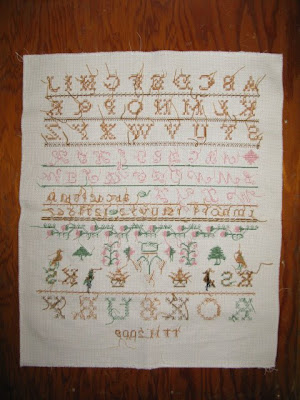
 During my first day of cross stitching in the More House, I accomplished more than I expected as I talked to museum visitors about the house and the sampler project. I finished twelve letters and considered it a major victory every time I completed one without having to fix a mistake (that only happened a handful of times). Most of the letters required fixing after I counted


