By: Marieanne Coursen, Agricultural Interpreter
In part one I showed the three varieties of pumpkins we grew this year at the Lippitt Farmstead. In addition to making a wonderful pie ingredient, pumpkin is also a great food for our farm animals. To make it easier for them to eat, it is first chopped into bite-sized pieces.
I offered the freshly chopped pumpkins to several of our animals at Lippitt Farmstead and got mixed results. The pigs of course ate them, but then, they will eat anything!
The turkeys were skeptical...
...the geese gave it a try...
...but in the end they were not interested.
The chickens, however, loved it!
Ollie, our Southdown sheep, remembered eating pumpkin in the past and dug right in.
The rest of the sheep were not impressed, but I have been feeding them pumpkin sprinkled with grain for several days and now they eat it right up. Animals tend to be neophobic and often hesitate to try new foods, but once they sample it with no bad results they are happy to add it to the menu.
Last but not least, Seraphina is a huge fan of pumpkin.
Of course this is only appropriate since you may recall from an earlier blog post, her namesake was also fond of pumpkin!
Showing posts with label Marieanne Coursen. Show all posts
Tuesday, November 29, 2011
Tuesday, November 22, 2011
Pumpkins for All: Part 1
By: Marieanne Coursen, Agricultural Interpreter
We grew three varieties of pumpkins on the Lippitt Farmstead this past summer. The New England Pie Pumpkin is an adorable small pumpkin, generally between five and eight pounds. This pumpkin is my personal favorite.
It has a wonderful sweet flesh that is excellent for pies.
The Long Island Cheese Pumpkin is a larger, buff-colored pumpkin also excellent for pies.
This pumpkin has a wonderful aroma when we cut it open. Shari, interpreter in the More House, made these beautiful pies with it, and I can attest that they were delicious!
This recipe is from The Frugal Housewife by Lydia Maria Francis Child, published in 1830.
These pumpkins will keep in a cool place for a few months but not necessarily until late winter or early spring, so some of the pumpkin is dehydrated for future use. One way to do that is to slice the flesh and hang the slices in the kitchen where they will dry from the warmth of the fire. Another way is to stew the pumpkin, then spread it on a pan and leave the pan in a warm oven until the pumpkin becomes leathery and can be lifted off the pan in one piece. Pat, our interpreter in the Lippitt Farmhouse, has been preparing much of our pumpkin this way.
The third pumpkin we grew was the Connecticut Field Pumpkin.
This is the type of pumpkin typically grown nowadays for Halloween. It is a large, nicely-shaped pumpkin, perfect for a jack-o-lantern. While it can be used for cooking, it is rather plain tasting and somewhat watery.
Its real claim to fame is as an animal feed. In part two of this blog post, I'll report the result of my farm animal survey regarding the eating of pumpkin.
We grew three varieties of pumpkins on the Lippitt Farmstead this past summer. The New England Pie Pumpkin is an adorable small pumpkin, generally between five and eight pounds. This pumpkin is my personal favorite.
The Long Island Cheese Pumpkin is a larger, buff-colored pumpkin also excellent for pies.
Although it has a pale outer skin, the flesh inside is a deep orange color.
This pumpkin has a wonderful aroma when we cut it open. Shari, interpreter in the More House, made these beautiful pies with it, and I can attest that they were delicious!
This recipe is from The Frugal Housewife by Lydia Maria Francis Child, published in 1830.
These pumpkins will keep in a cool place for a few months but not necessarily until late winter or early spring, so some of the pumpkin is dehydrated for future use. One way to do that is to slice the flesh and hang the slices in the kitchen where they will dry from the warmth of the fire. Another way is to stew the pumpkin, then spread it on a pan and leave the pan in a warm oven until the pumpkin becomes leathery and can be lifted off the pan in one piece. Pat, our interpreter in the Lippitt Farmhouse, has been preparing much of our pumpkin this way.
The third pumpkin we grew was the Connecticut Field Pumpkin.
This is the type of pumpkin typically grown nowadays for Halloween. It is a large, nicely-shaped pumpkin, perfect for a jack-o-lantern. While it can be used for cooking, it is rather plain tasting and somewhat watery.
Its real claim to fame is as an animal feed. In part two of this blog post, I'll report the result of my farm animal survey regarding the eating of pumpkin.
Labels:
Farming,
Harvests,
Marieanne Coursen,
Pumpkin Fest
Tuesday, June 28, 2011
Poultry News at Lippitt Farmstead
By: Marieanne Coursen, Agricultural Interpreter
Here is a May update from Marieanne - stay tuned for a more recent update and pictures of the chicks next week!
It is May 15th and our Mama Hen is doing great. Eleven eggs were set under her on April 27th in the broody coop. Every day we let her out late in the morning. I always have to pick her up off the nest and push her out the door of the coop.
Once she is out, she has a regular routine. She scratches in the garden eating worms and insects, clucking constantly and puffing out her feathers like a typical broody hen. At some point she squawks and runs for a short distance, and she spends quite a bit of time dusting in the dirt.
Then she eats the food I have put out for her and drinks some water. I feed her a mix of whole grains – corn, barley, oats and wheat. I have looked in several poultry books from the 19th century and they all recommend feeding only whole grains to a broody hen although they don’t explain why. My guess is that she shouldn’t eat a diet that is formulated for laying hens since she isn’t laying eggs at this time; and I also think the whole grains go through her system more slowly which is probably a good thing since she only gets to eat once a day. Because she is eating whole grains it is particularly important that she has access to grit which is readily available in the garden in the form of small stones.
The first few days I had to herd her back into the coop after a half hour but soon she started going back on her own. As we get closer to hatch date she seems to stay out for a shorter time and she always goes back more quickly on cool day.
We found one of the eggs broken one day. I think it probably cracked when the hen was picked up to go out for the day because I heard the sound of 2 eggs clacking together and 2 days later we found the broken egg pushed out of the nest. So there are 10 eggs left that will hopefully hatch on Wednesday, May 18th.
In other poultry news, our turkey hen has laid 9 eggs so far in the barrel we placed on its side in the turkey house. Another chicken hen is setting on 5 duck eggs. And we have added 8 goslings to the farm. They hatched on April 18th and arrived by mail on April 20th.
With all this activity on the farm, I am finding it harder and harder to get away to the computer so we may have to rely on Facebook postings for a while for the new news from the farm or better yet, come see us for real and check out the latest farm happenings!
Labels:
Animals,
broody hen,
chickens,
Lippitt Farm,
Marieanne Coursen,
Poultry
Thursday, June 23, 2011
What Will I Be When I Grow Up?
By: Marieanne Coursen, Agricultural Interpreter
While visiting with my mother recently, I was looking through old photographs and found this one:
That is me when I was twelve years old and on vacation with my family. I had never been that close to oxen before and never was again until I began working at The Farmers’ Museum.
Today I am the ox teamster for The Farmers’ Museum and have had the pleasure of training our team of oxen, Jiggs and Buckwheat, who were born here on the farm and are presently 4 ½ years old:
When I was asked as a child what I wanted to be when I grow up, my answer never was “An ox teamster!” You just never know!
While visiting with my mother recently, I was looking through old photographs and found this one:
That is me when I was twelve years old and on vacation with my family. I had never been that close to oxen before and never was again until I began working at The Farmers’ Museum.
Today I am the ox teamster for The Farmers’ Museum and have had the pleasure of training our team of oxen, Jiggs and Buckwheat, who were born here on the farm and are presently 4 ½ years old:
When I was asked as a child what I wanted to be when I grow up, my answer never was “An ox teamster!” You just never know!
Labels:
Marieanne Coursen,
Oxen
Tuesday, May 3, 2011
We’ve Got a Broody Biddy!
By: Marieanne Coursen, Agricultural Interpreter
One of our hens has been in a nest box in the chicken house every time I look in. I tied a string to her leg to make sure it was indeed the same hen every time since they all look alike. She definitely appears to be a broody hen, in other words she is done laying eggs for now and wants to “set” or sit on eggs until they hatch. She has that “Do Not Disturb” look about her:
I placed 3 duck eggs under her to help her stay in the mood while I got the broody coop ready. I used duck eggs because we collect the eggs from the nest boxes twice a day so it is easier to remember which eggs to leave alone should the broody hen be off the nest.
Meanwhile the new broody coop was moved to the Lippitt garden.
I left out the wood floor for now because the dampness of the ground is beneficial to the development of the eggs. I chopped some straw nice and short and placed it in the coop. If left long, the straw can get caught on the hen’s feet when she leaves the nest and she could drag the eggs out. Then I hollowed out a spot in the back of the coop and placed three eggs in it. The coop was ready.
The hen must be moved in the dark so that she is more likely to accept the new location. This was rather inconvenient since I am not at work when it is dark but it just so happened that I would be in town last Wednesday evening for dinner. So during the day on Wednesday I dusted Mama hen with Ectiban and that night she was quietly moved to her new location. The Ectiban prevents lice and mites. I sprinkled some in the nest also. In 1845 sulphur was used for this purpose. Chickens like to “dust” or lay in the dirt flapping their wings and rolling around to get the dirt down in their feathers and then shake themselves as their own prevention against parasites.
Unfortunately I would not be back at work again until the following Tuesday, but the hen was in good hands with farmers Wayne and Rick while I was gone. On Thursday Wayne let her out to eat, dust and exercise. She did just that, but instead of going back in to the broody coop, she went back to the henhouse and her old nest box. Wayne had to catch her and put her back in the coop. He decided to leave her in there and put food and water in the coop until I got back.
This was her probationary period to see if she was really going to stay devoted to the nest and her job as broody hen. Today I am back at work and so I let her out again. When I opened the roof of the coop she was sitting tight to the nest of eggs. I had to chase her off so I would say she is definitely still in broody hen mode. She spent about a half hour eating and dusting. She almost went back to the nest on her own but in the end I had to catch her and put her back. I would prefer that she go back on her own but it may take a few days for her to understand the routine.
She was fun to watch while she was out and about. The had her tail feathers all fluffed up and she had an important, busy air about her, clucking the entire time.
So the plan is that tomorrow I will let her out about the same time again to eat and exercise. While she is busy outside, I will replace the 3 eggs with the 11 eggs I want her to hatch. Then the countdown will begin. Everyday she will be let out of the coop at about the same time and I will make sure she doesn’t stay out more than a half hour – less time if it is really cold. Stay tuned for updates on how it is going with Mama hen and her clutch of eggs!
Tuesday, March 29, 2011
Lippitt Farmstead in Winter – Birds, Bees and Building Projects
By: Marieanne Coursen, Agricultural Interpreter
During the winter, while the museum is closed, it is a good time to mull over ways we can improve our efforts to interpret farming in the 19th century to our modern public. This winter I came up with two projects that I hope will enhance our interpretation.
A Broody Coop
Today most chicks are produced using incubators – cabinets that produce an environment that simulates the one provided by a mother hen. In 1845, a farmer would depend on a “broody” hen to hatch eggs. This winter Farmer Wayne was kind enough to help me build a broody coop. This is just a small container to keep a hen comfortable and safe from predators or interference from other hens while she is setting on eggs. It does not need to be fancy; it can be an old wood barrel turned on its side with a front made of wire or lath added, or a wood shipping crate can be converted to a fine broody coop. For our broody coop, however, we used a design from a text book written for an industrial arts class in 1916. It really is like a small dog house, larger than what the hen needs to just hatch the chicks, but this way it will serve as a home for her and the chicks for a while after they hatch. We made this extra sturdy version because we want it to be very safe against predators. The local wildlife around here is well aware that we really aren’t farmers in 1845 with a protective dog and a shotgun at the ready, so we need to take extra precautions.
My plan is to put the broody coop in the back garden and set a broody hen in it this spring. I will be sure to keep everyone posted on this project.
Beehives
Beekeeping was probably as common in 1845 as it is today - not everyone does it but there are plenty of people who do. We keep a few hives here at the museum and offer two beekeeping workshops every year. These hives are located on the grounds, but they are strategically placed high on a hill in a pasture where visitors can’t get very close, obviously to avoid the possibility of bee stings.
I have struggled with how to make beekeeping more of a daily hands-on part of interpretation, so this year we are adding two beehives right by the barns at the Lippitt Farmstead. One hive will be the standard Langstroth hive that was developed by Reverend Lorenzo Langstroth in the mid-nineteenth century and is still widely used by beekeepers today. Instead of live bees, this hive will contain frames with pictures of what you might see “if” it were a live hive. It is an excellent teaching tool sold by Brushy Mountain Bee Farm.
The second hive, will be a reproduction of an old hive in our collection. It is a simple primitive hive made from rough lumber. This is a project I can handle. No scary power tools or high degree of skill required. I am nearly finished and have done it all with “found lumber” and hand tools just like I imagine the original maker did. This hive will be kept free of bees also so that we can freely look inside with our visitors.
Hive, Collection of The Farmers' Museum, Cooperstown, NY F0068.1983
These hives will give us an opportunity to let visitors manipulate a hive without risk of being stung and will be an excellent prop to enhance our discussions about beekeeping.
This ends my Winter at Lippitt Farmstead series; after all, it is spring! April 1st is opening day and I am looking forward to talking with everyone face to face and sharing our farm from the barnyard instead from our office!
Wednesday, March 23, 2011
Lippitt Farmstead in Winter: A New Experience for Jiggs and Buckwheat
By: Marieanne Coursen, Agricultural Interpreter
Our museum teachers include among their offerings, a tour based on the book, Ox Cart Man.
I try to make sure I have Jiggs and Buckwheat, our team of oxen, hooked up to their cart when I know this tour is being given to enhance the children’s experience. However, the book features a single ox pulling a cart, so it has been my hope for a long time to hook a single ox to a cart to go along with the story. It looks like I will finally be able to make it happen. This winter we bought a single ox yoke from Nathan Hine (www.thehinefamily.com) in Massachusetts . After it arrived, I brought it to Pete, in our paint shop, and we selected an historical color blue.
Next we needed a britchen. We happened to have one that had been hanging in the barn for years. The britchen is just a simple harness that is particularly helpful when using a single ox because it helps stabilize the yoke and also allows the ox to use his rump to hold the cart back on a hill or back it up by pushing into the britchen rather than using the back of his horns against the yoke. We also needed to come up with a back pad with loops to hold the shafts of the cart up. This we robbed from an old horse harness. After lots of tweaking and hunting for bits of hardware and leather, Farmer Wayne and I were ready to do a test drive. Jiggs was our guinea pig. He is generally the more laid back of the two, so it seemed like a good idea to use him for our first try.
He was a little nervous about these new sensations on new areas of his body, but he settled into it quickly. So we headed out for a walk around the grounds.
He did really well. What was really interesting was how Jiggs responded when I asked him to back up. Once he felt how it worked, he really seemed to like that he just had to lean back in the harness rather than push back with his head. All in all, he did very well on his first solo. Another day I will give Buckwheat a try.
This has been a fun winter project and it is great to add to the versatility of our team of oxen. Besides complementing the Ox-cart Man tour, a single ox will be useful for cultivating the gardens where a team would be too wide and for other jobs where less power is required.
Labels:
Animals,
Lippitt Farm,
Marieanne Coursen,
Oxen,
Single Ox
Wednesday, March 2, 2011
We are getting ready!
By: Marieanne Coursen, Agricultural Interpreter
Jiggs and Buckwheat wait patiently while I unchain the pole we brought up from the drive shed. It will be the top of our nineteenth-century fire arch:
Cement block fire arch in progress:
Farmer Wayne tapping a maple tree on The Farmers’ Museum grounds along Route 80:
This Sunday starts Sugaring Off at The Farmers’ Museum! I can’t wait to see all our old friends and meet lots of new folks, too. As always, there is a great breakfast to be had in the Louis C. Jones Center in our main barn, our shops will be open, the schoolhouse will have fun activities, maple goodies will be baking in the More House oven, the blacksmiths will be banging their hammers, and of course we will be gathering and boiling sap and doling out jack wax. Come dressed for mud and let’s talk maple!
Jiggs and Buckwheat wait patiently while I unchain the pole we brought up from the drive shed. It will be the top of our nineteenth-century fire arch:
Cement block fire arch in progress:
Arches up, picnic tables in place, firewood stacked and covered:
Farmer Wayne tapping a maple tree on The Farmers’ Museum grounds along Route 80:
Farmer Wayne ready for me to ask Jiggs and Buckwheat to move the cart on to the next tree:
Sap dripping!
Barrels being filled daily with water to swell the wood so that they will hold the sap:
Labels:
Farmer Wayne,
Harvests,
Marieanne Coursen,
Oxen,
Sugaring Off
Tuesday, February 22, 2011
Lippitt Farmstead in Winter: Cows
by: Marieanne Coursen, Agricultural Interpreter
The Marble Barn is home to our cows in the winter. Like Zeb, our horse, the cows spend their days outside where we feed them hay; then at night they come into the barn for more hay, some grain, and a nice bed of straw.
We keep two breeds of cattle, Milking Devons and Milking Shorthorns. Both were common breeds during the mid-19th century.
Begonia, a Milking Devon, is three and a half years old and has developed some very nice horns:
She will be having her second calf this summer. Her first calf was a bull who we castrated last fall. He is growing into a fine beef steer:
Duchess, also a Milking Devon, is identified as a heifer because she is young and has not yet had a calf:
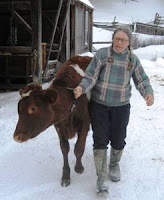
And then last - but not least - is Seraphina, our Milking Shorthorn. Her dam is Daisy Mae and her granddam is Buttercup. For those of you who have been here at chore time in the past, you may remember milking one or the other. Someday Seraphina will be the cow that you come to milk, but for now she still has some growing up to do. As you can see she is doing just that – she has gotten a bit taller since the blog post last summer when we showed her posing with Hugh McDougall, the winner of our naming contest.
She also had a mind of her own when we wanted to take the picture today and she dragged me all over the barnyard, but generally she is a very sweet heifer who enjoys attention. She is my favorite!
Monday, February 14, 2011
Lippitt Farmstead in Winter: Sheep
By: Marieanne Coursen, Agricultural Interpreter
Our ewes have been entertaining a guest this winter. He arrived on December 4th.
He is a handsome Border Cheviot ram from Millers Cheviot Acres in New Berlin, New York.
During the breeding season, ewes come into heat approximately every 17 days. They will be in heat (in other words, receptive to the ram) for 24 to 36 hours. We are keeping the ram here until February 1st to allow ample opportunity for him to catch each of the ewes in heat and breed them.
Our ewes have been entertaining a guest this winter. He arrived on December 4th.
He is a handsome Border Cheviot ram from Millers Cheviot Acres in New Berlin, New York.
During the breeding season, ewes come into heat approximately every 17 days. They will be in heat (in other words, receptive to the ram) for 24 to 36 hours. We are keeping the ram here until February 1st to allow ample opportunity for him to catch each of the ewes in heat and breed them.
Three of our ewes are exposed to the ram. Daisy is a Border Cheviot, so any lambs she has will be pure Border Cheviot:
The other two, Ollie and Dancin’, are Southdowns so their lambs will be Cheviot/Southdown crosses:
Some shoot for the Easter market, so they want their lambs born in January and February to reach market weight by Easter. These lambs are called hothouse lambs. Other shepherds are more interested in taking advantage of lush pasture in summer, so they want lambs born in spring to sell as feeder or market lambs in the fall. Our goal as a living history museum is to have our lambs born at a time appropriate to the 1800s, but also to share this precious time with our visitors. Given the above information and the fact that gestation is 150 days you may want to plan a spring visit with us during lambing time – I’ll let you do the math.
Labels:
Animals,
lambs,
Lippitt Farm,
Marieanne Coursen,
Sheep
Subscribe to:
Posts (Atom)