By: Keelin Purcell, Manager of School and Farm Programs
In
preparation for a new Lippitt Farm Walk and Talk program, my intern Jenna and I
did a lot of research on farms in 1845. One of the topics that I explored was
the history and use of the potato (Solanum
tubersoum).
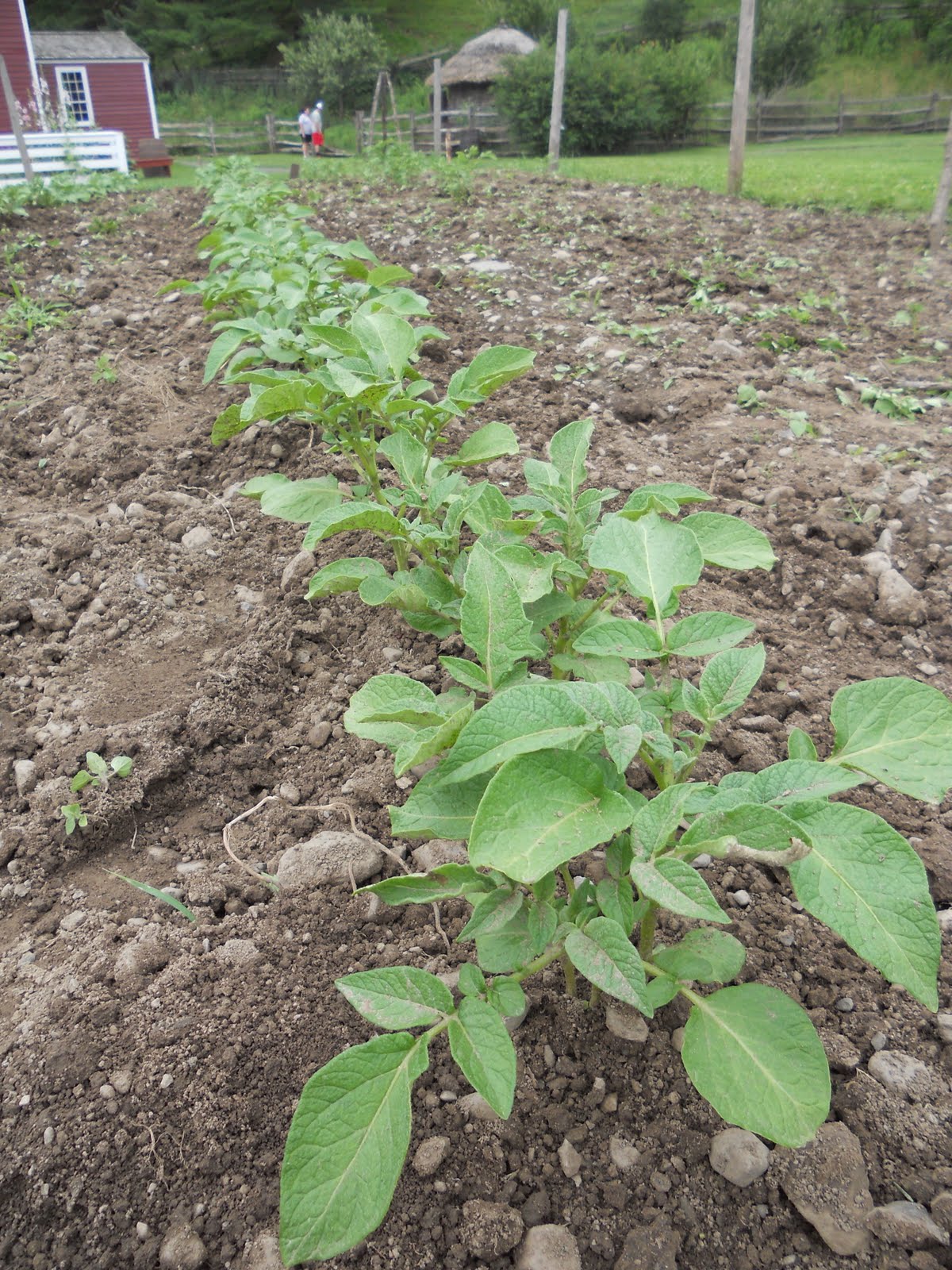 |
| Our potatoes growing in early July. |
Potatoes
are fascinating in that they are so prevalent in our culture’s food, and yet
many people do not recognize the growing plant. Make sure to visit to see and
touch the plants growing in our Interpretive
Field Garden
 |
| Our potatoes growing in early August. |
Potatoes
were very important in 1800s agriculture. They supplanted many other root
crops, in part because they can be easily propagated asexually by cutting up
(eyeing) and planting the previous year’s potatoes. An acre of potatoes also
produces four times more dietary calories than an acre of grain.
Because potatoes do not grow true
to type, they were almost always propagated asexually. However, by growing them
to seed, many different varieties were produced. In 1845, there was a large
selection of potato varieties to choose from, though most families grew one or
two types. Potato epidemics were fairly common, because all the potatoes of a
given type were clones and therefore very susceptible to contracting the same
disease.
 |
| Potato choices from a 1881 seed catalog in the collection of the NYSHA Research Library. |
Potatoes
are harvested once the tops die back and would have been dried before going
into the root cellar. Potatoes were steamed, mashed, boiled, fried, and
roasted, as well as made into flour and starch.

This
year we are growing Green Mountain , Red Natural, and Kennebec potatoes in our Interpretive Field Garden


 Most homes in the 19th century had cellars under the house for preserving vegetables. Climate-wise cellars were cool and moist, the ideal environment for cabbage, apples and most root crops. For those who did not have large enough cellars (or no cellar at all), certain vegetables were overwintered in the garden in straw lined trenches or hills that were covered over with more straw and soil.
  When the vegetables are dry enough they are carried to the cellar for winter storage. In the Lippitt Farmhouse cellar we use large footed wooden bins with wire tops to store our root crops, barrels for apples and we hang the cabbages by their roots.
  The productive root cellar is one that is well tended. It’s important to cook the soft vegetables, throw away the rotten ones and keep rodents away.
  About a week ago we harvested
  Root crops were the primary vegetable foodstuffs grown for much of the 19th century due to the available technology for the long term preservation of foodstuffs. A permanent method of freezing was not available and home canning did not become a common method of food preservation until the latter part of the 19th century. What couldn’t be put down in the cellar was “put up,” hung up to dry. All you would have needed was the correct environment and the “know how” for the successful storage of most of the vegetables grown in the 19th century.
  Harvesting this year was easy. I hate to say it, but it only took a few hours to bring all the vegetables in. It was not a good growing year. The vegetable yield this year was only a fraction of what we normally grow in a good year. The vegetables overall were in good condition but in size they were small to the occasional large.
  The five beds in Lippit Garden Our Kitchen Garden at the Lippitt Farmhouse is laid out as a garden would have been for much of the nineteenth century: geometrically in beds. The garden consists of five beds. Three of the five as of this writing are slowly growing. Two, because they were either under water or wet most of the summer were a lost cause by July. At this point we are harvesting potatoes, turnips and early cabbage for use, but is looking like we won’t have much to “put down“ in the cellar for winter use. For the most part though, the development of the vegetables is where they would be the end of July or early August even though it’s already mid-September.
 A bed with growing plants.
  A bed that is too wet.
  Small turnips Lessons from this cold, wet summer:
 Second, we put the frame together on top of the horse manure facing southeast. Third, we began to fill the frame with manure, firmly stomping the manure every 6” until it was about 8” from the top of the frame.
 Fourth, we covered with 6” of soil composted from last years’ frames, and then put the window sash on.
 Finally, we let the frame set for several days as the manure heated up to 125 degrees. If you plant your seeds right after creating your frame, the temperature will be too hot and you will scald your plants. When the temperature dropped to 85 degrees, I planted the frame and watered it. Sprouts began to appear before the first week was up, and after a few weeks, our hot frame is full of healthy plants on their way to maturity.

 My first workshop experience was at our Heritage Vegetable Garden class in early April. We learned about historic vegetable growing, usage, and storing first, and then got to try our hands at building a hot frame. Hot frames are designed to give you a head start on spring planting. How? By using horse manure as a fuel to keep the inside of a wooden box warm enough so that seeds and plants can grow. Building the hot frame was definitely a workout for me and my fellow workshop participants, but it was incredibly satisfying. Make sure to check out Gwen Miner’s post about hot frames to learn more about the specifics and to see how our plants are doing in the completed frame.
 If jumping on a big pile of straw and manure wasn’t enough to get me excited about the opportunities on the farm, then I certainly got a taste of the hard work of farming in the second workshop I attended, our Farm Chores workshop. This workshop is designed to give visitors a taste of what getting the farm ready in the morning really means. I did everything from throwing hay bales from the loft, to letting out the animals (did you know the preferred language for steering sheep to pasture is “good day”?), mucking stalls, harnessing Zeb the horse, and cultivating a few rows in our hop field. I was tired and smelly by the end of the morning, but I had a truly wonderful time.

 If this has whet your appetite for getting your hands dirty in one of our workshops, make sure to check out the
 .JPG)


