There is a tale from a long time
ago that tells of a great naval battle. Homelands are to be protected and
invaders to be pushed back. Ships crash against waves and fail to see the rocky
shore line, breaking into pieces. The surviving crew swim desperately to shore
avoiding the dangerous rocks, finally getting precious land under their legs.
They struggle onto shore wet and bedraggled to a new life and a new home, a
home that their descendants would grow up in and adapt to.
 |
| Our two full grown Cheviot sheep, Bonnie Jane (left) and Daisy (right) relax in the field. |
There has long been speculation that Cheviot sheep could
have been descendants of the sheep that may have escaped from ships in the
Spanish Armada. The American Cheviot Sheep Society includes a brief history of
the breed in one of their Flock books and they mention such a story. But they are
not completely convinced, saying, “This tale, however, has also been given in
explanation of the origin of yet other breeds, so that coming from the sea, we
may accept it as somewhat fishy in flavor and quality.” Instead, they feel that
the Cheviot’s had been living in the Cheviot Hills between England and Scotland for a long time and were
originally called “long sheep”. Slowly the name changed to Cheviot sheep, after
the Cheviot Hills where they lived.
Whether or not the origins of the Cheviot breed began with
heroic sheep swimming ashore or by humbler means, the breed’s introduction to
the United States
is less mysterious. They arrived later than the Tunis ,
around 1838, and were imported right into the state of New
York by Robert Young of Delaware
County United States
in 1842, brought by George Lowe, and came to live not far from here in
Hartwick. The breed spread into the southern counties of New
York , especially our very own Otsego County
Like the Tunis
sheep, Cheviots are listed as a meat breed by the American Sheep Industry
Association, but this does not mean that their wool is useless. In fact the historic
American Cheviot Sheep Society found great pride in Cheviot wool, claiming that
it has fewer oils in it than other sheep and, when washed clean, it is the
whitest wool on any sheep. In fact even in the field you can identify the
Cheviots by their very white wool.
 |
| A close up of Daisy (front left) and Bonnie Jane (front right), with our Tunis sheep in the background. |
Next time you visit the Lippitt Farm, see if you can tell
the difference between our sheep. The Tunis
has red or light brown legs and face with cream colored wool. The Cheviot has
white wool and a white face with no wool on the legs. Any sheep that does not look
like these two must be the sheep for the next post, the Delaine- Merinos! So
come stop by; Bonnie Jane, Daisy and their lambs always love visitors!



 Once she is out, she has a regular routine. She scratches in the garden eating worms and insects, clucking constantly and puffing out her feathers like a typical broody hen. At some point she squawks and runs for a short distance, and she spends quite a bit of time dusting in the dirt.
 Then she eats the food I have put out for her and drinks some water. I feed her a mix of whole grains – corn, barley, oats and wheat. I have looked in several poultry books from the 19th century and they all recommend feeding only whole grains to a broody hen although they don’t explain why. My guess is that she shouldn’t eat a diet that is formulated for laying hens since she isn’t laying eggs at this time; and I also think the whole grains go through her system more slowly which is probably a good thing since she only gets to eat once a day. Because she is eating whole grains it is particularly important that she has access to grit which is readily available in the garden in the form of small stones.
 The first few days I had to herd her back into the coop after a half hour but soon she started going back on her own. As we get closer to hatch date she seems to stay out for a shorter time and she always goes back more quickly on cool day.
 We found one of the eggs broken one day. I think it probably cracked when the hen was picked up to go out for the day because I heard the sound of 2 eggs clacking together and 2 days later we found the broken egg pushed out of the nest. So there are 10 eggs left that will hopefully hatch on Wednesday, May 18th.
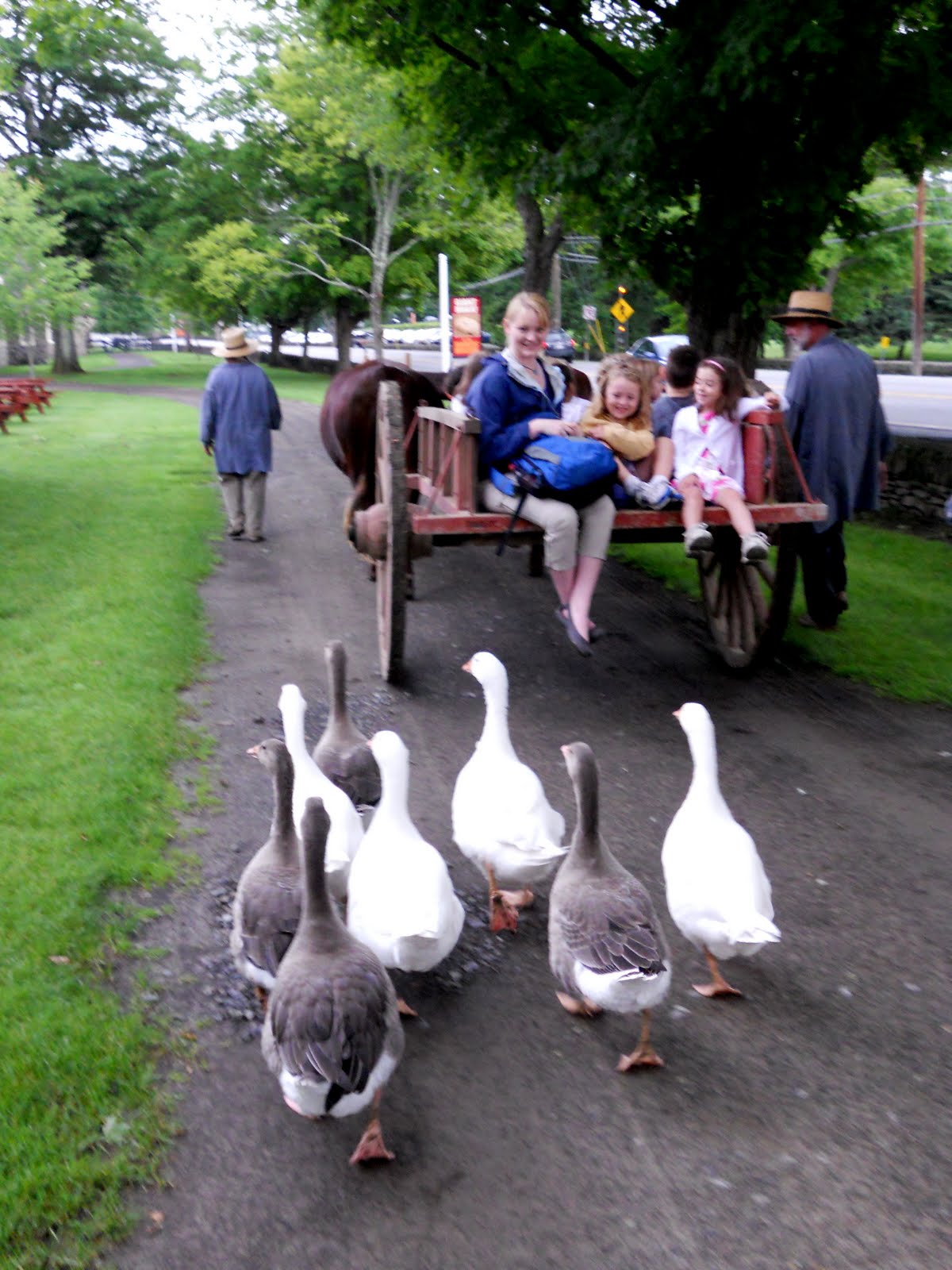
In other poultry news, our turkey hen has laid 9 eggs so far in the barrel we placed on its side in the turkey house. Another chicken hen is setting on 5 duck eggs. And we have added 8 goslings to the farm. They hatched on April 18th and arrived by mail on April 20th.
With all this activity on the farm, I am finding it harder and harder to get away to the computer so we may have to rely on Facebook postings for a while for the new news from the farm or better yet, come see us for real and check out the latest farm happenings!
We found one of the eggs broken one day. I think it probably cracked when the hen was picked up to go out for the day because I heard the sound of 2 eggs clacking together and 2 days later we found the broken egg pushed out of the nest. So there are 10 eggs left that will hopefully hatch on Wednesday, May 18th.
In other poultry news, our turkey hen has laid 9 eggs so far in the barrel we placed on its side in the turkey house. Another chicken hen is setting on 5 duck eggs. And we have added 8 goslings to the farm. They hatched on April 18th and arrived by mail on April 20th.
With all this activity on the farm, I am finding it harder and harder to get away to the computer so we may have to rely on Facebook postings for a while for the new news from the farm or better yet, come see us for real and check out the latest farm happenings!