By: Garet Livermore, Vice President for Education
“Chill November's surly blast makes fields and forests bare and old man Winter with his frosty beard will soon be upon us.” - The Cultivator, Journal of the New York Agricultural Society, December, 1860.

Planning for winter began right when farms were laid out, to simplify and manage the extremes of our northern climate. Farmhouses were placed close to roads to ease access and snow clearing issues, while barns and barnyards were set to shield humans and animals from the worst of the weather while maintaining an efficient work area. In extreme northern locations, farmers would actually build their houses, barns and outbuildings in a single, connected structure so they would always be sheltered during storms. The danger of fire taking out an entire farm was too great to do this in most of the Northeast.

Most early settlers in rural New York came from New England and were used to dealing with long, cold winters. The designs of their houses reflected this experience. Predominant forms were Cape Cod, salt boxes and federal styles well adapted to the climate. They featured large centrally massed chimneys which provided for several fireplaces and large amounts of brick to hold heat, steep roofs to shed heavy snow loads and relatively small rooms with low ceilings to conserve heat. Visitors to the Lippitt House at The Farmers’ Museum often comment on those rooms and ceilings, believing that their size is because “people were shorter back then”. Actually it is simply one example of a New England saltbox house built to conserve heat during the upstate winters.


In the early 19th century open fireplaces were the predominant form of providing heat for comfort and cooking. The fireplaces of this time were heavily influenced by the work of Sir Benjamin Thompson (1753 – 1814), otherwise known as Count Rumford. Thompson was a scientist and inventor who is credited with inventing, amongst other things, the kitchen range, drip-coffee pot and thermal underwear. A Massachusetts born New Englander, it is fitting that his most influential work was the Rumford fireplace, which offered great improvements in fireplace efficiency and effectiveness in heating. His fireplaces were relatively shallow, to project more heat into the room and had a very narrow “throat” or opening into the chimney which increased the draw of the fire to reduce smoke and enhance combustion.

As anyone who has done a “gut restoration” can tell you, there are many interesting things to be found in the walls of an old house including shoes, skeletons of small animals and sometimes, for lucky renovators, coins and currency. One rarely finds insulation, though. This wasn’t because insulation wasn’t known at the time: it was. In fact, the concept of building insulation has been around for centuries, dating to at least Greek and Roman times. In early America, insulation was an expensive proposition and only used in buildings built in very exposed, windy locations. Sometimes the insulation consisted of loosely laid brick “nogging” placed between the vertical elements of buildings framed. Other times builders would tightly pack sawdust, wood chips or other material in the walls of houses creating a heat barrier similar to today’s fiberglass batting. Most often, farmers simply “banked” the house by piling straw, hay or other loose materials against the foundation to keep the cold winter winds out of their cellars. This helped keep their potatoes and other foods in the cellar from freezing and spoiling, and also helped keep the house a bit warmer. The illustration at the top of this blog post shows a house “banked” for winter.

In the latter part of the 19th century many entrepreneurial businessmen started recycling industrial by-products left over from textile mills and factories as insulation. These included wood fiber from lumber mills, animal hair from slaughterhouses and cotton and flax remnants from textile mills. Each of these shared the characteristic of being fibrous material that was well suited to make into batts or panels for placement in walls. Perhaps the most unusual insulation material in common use was eel grass, the “seaweed” that you see piled up in windrows along New England’s beaches. Its use in homes started in Colonial times and extended through the 1940s. Samuel Cabot of Boston created a product called “Cabot’s Quilt” in 1893 where he stitched compressed eel grass between two layers of Kraft paper. The insulation was on the market for many years and because of its sound deadening qualities, used in many theatres and office buildings, including Radio City Music Hall and Rockefeller Center in New York City.

As anyone who has done a “gut restoration” can tell you, there are many interesting things to be found in the walls of an old house including shoes, skeletons of small animals and sometimes, for lucky renovators, coins and currency. One rarely finds insulation, though. This wasn’t because insulation wasn’t known at the time: it was. In fact, the concept of building insulation has been around for centuries, dating to at least Greek and Roman times. In early America, insulation was an expensive proposition and only used in buildings built in very exposed, windy locations. Sometimes the insulation consisted of loosely laid brick “nogging” placed between the vertical elements of buildings framed. Other times builders would tightly pack sawdust, wood chips or other material in the walls of houses creating a heat barrier similar to today’s fiberglass batting. Most often, farmers simply “banked” the house by piling straw, hay or other loose materials against the foundation to keep the cold winter winds out of their cellars. This helped keep their potatoes and other foods in the cellar from freezing and spoiling, and also helped keep the house a bit warmer. The illustration at the top of this blog post shows a house “banked” for winter.
In the latter part of the 19th century many entrepreneurial businessmen started recycling industrial by-products left over from textile mills and factories as insulation. These included wood fiber from lumber mills, animal hair from slaughterhouses and cotton and flax remnants from textile mills. Each of these shared the characteristic of being fibrous material that was well suited to make into batts or panels for placement in walls. Perhaps the most unusual insulation material in common use was eel grass, the “seaweed” that you see piled up in windrows along New England’s beaches. Its use in homes started in Colonial times and extended through the 1940s. Samuel Cabot of Boston created a product called “Cabot’s Quilt” in 1893 where he stitched compressed eel grass between two layers of Kraft paper. The insulation was on the market for many years and because of its sound deadening qualities, used in many theatres and office buildings, including Radio City Music Hall and Rockefeller Center in New York City.


 I had forgotten to bring my watch with me, but thanks to the many activities during the day I usually knew the approximate time. The morning flew by with quilting a pot holder and talking to visitors, and I didn’t think about the time until the noon whistle blew from downtown Cooperstown.
  The loud pounding from the Williams Carriage Shed (the only noise louder than the blacksmith during the day) signaled the 2:00 flax processing demonstration, and visitors began congregating in the More House a little before 3:00 to take a tour with me of the second floor. By about 3:20 the grounds quieted as visitors gathered at the farmstead to


 I was mostly interested in the earliest part of the mill’s history, since both the Lippitt and More families also operated mills to supplement their farming income. I had visited the museum before, but it was the first time I’d gone since starting to work in the More House, and I can now envision what a mill looks like much more clearly when I talk to visitors about the Mores and their occupations. Reversely, my experience at The Farmers’ Museum was greatly enriched since I could understand how the mill in East Meredith connected to the farm life I know from The Farmers’ Museum. This kind of experience isn’t just helpful for people like me who work at museums – it’s also great for visitors! Hanford Mills Museum, along with The Farmers’ Museum and the Fenimore Art Museum, is now part of the
 Several people on the interpretive staff are working together to make a log-cabin-patterned quilt. The quilt will be made up of seven sets of squares; each square is predominantly one color and we are making seven squares of each color. This is called scrap quilting because we use scraps of fabric that are left over from making clothing and other items. After

 The wallpaper – and the carpets, curtains, and painted graining on the wood panels and doors – reflects the way that the Mores and other families decorated their homes. Because of their wealth, Jonas and Deborah More could afford a greater amount and more expensive decorations, but all families decorated their homes to some degree with similar kinds of treatments.
 The painted surfaces are the most accurate reproductions of the original treatments in the house. Since we could still see the first layers of paint on the walls and doors, like this door in the kitchen, painters could replicate the original red color with painted graining.
 Things like wallpaper, carpeting, and curtains, on the other hand, did not survive. Instead, we chose reproductions with colors and patterns that made sense with the paint colors, and that we know other families used in central New York during the nineteenth century. The overall effect of the decorative treatments, while sometimes jarring to our modern eyes, is the most effective way to teach visitors about the popular styles during the Mores’ lives.
 I love this new group! Not only does it add to the activity in the More House, but I’m learning new things every week about bandboxes and how they’re made. It’s also fun to see even more colorful wallpaper than already covers the walls in the house (more on the More House wallpaper in a future post).
Bandboxes originally were made in England and served to store men’s detachable neck bands (collars). By the nineteenth century, Americans had adapted bandboxes to store a wide variety of hats, accessories, and other trinkets; women also used them as luggage while traveling.
If you are interested in volunteering on this project, please contact our Volunteer Administrator at volunteers@nysha.org. The bandboxes are also available for sale at Todd’s General Store.
I love this new group! Not only does it add to the activity in the More House, but I’m learning new things every week about bandboxes and how they’re made. It’s also fun to see even more colorful wallpaper than already covers the walls in the house (more on the More House wallpaper in a future post).
Bandboxes originally were made in England and served to store men’s detachable neck bands (collars). By the nineteenth century, Americans had adapted bandboxes to store a wide variety of hats, accessories, and other trinkets; women also used them as luggage while traveling.
If you are interested in volunteering on this project, please contact our Volunteer Administrator at volunteers@nysha.org. The bandboxes are also available for sale at Todd’s General Store.
 As I’ve stitched in the More House, many visitors have asked what will happen to this sampler. It will stay in the More House for visitors to see. In the entire scope of the project, though, I still have far to go. My next step will be to go back to the original sampler to check against my first try, note my mistakes, and fix anything major on this sampler. Then I will start matching thread colors and material so I can start on an even bigger task: reproducing, as much as possible, the original sampler on linen cloth (without the benefits of the grid-like aida cloth). But after this one, I’m feeling much more ready for the challenge!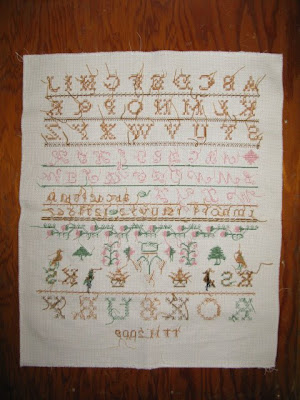
 During my first day of cross stitching in the More House, I accomplished more than I expected as I talked to museum visitors about the house and the sampler project. I finished twelve letters and considered it a major victory every time I completed one without having to fix a mistake (that only happened a handful of times). Most of the letters required fixing after I counted
 I made the Maple Tea Cake using two different shortenings. I used lard in one and butter in the other and got two different results. Both results were good; the cake with lard was lighter and dryer and had a hint of the “lard” while the butter cake was sweeter and chewier. I conducted an informal taste test on Monday with co-workers who decided that the butter cake was better.
Following is the recipe as written in the book and in parentheses are the two shortenings and suggested sugar conversions.
I made the Maple Tea Cake using two different shortenings. I used lard in one and butter in the other and got two different results. Both results were good; the cake with lard was lighter and dryer and had a hint of the “lard” while the butter cake was sweeter and chewier. I conducted an informal taste test on Monday with co-workers who decided that the butter cake was better.
Following is the recipe as written in the book and in parentheses are the two shortenings and suggested sugar conversions. 




