Showing posts with label Junior Livestock Show. Show all posts

Tuesday, August 3, 2010

Portraits from the Junior Livestock Show

By: Garet Livermore, Vice President for Education
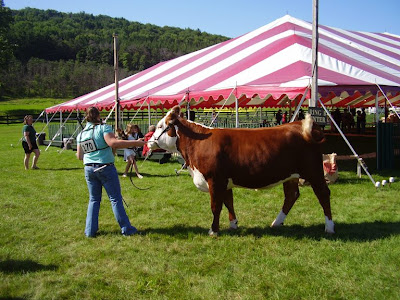
One of the most important traditions of The Farmers’ Museum is its annual Junior Livestock Show. Established by Stephen C. Clark Jr. in 1947, the Junior Show has brought children from throughout Central New York to show their sheep, dairy goats, swine, dairy cattle and beef cattle to Cooperstown to participate in one of the largest events of its kind in the Northeast. The show is run cooperatively by the museum with the Cooperative Extension staff of the following counties:

• Otsego
• Delaware
• Schoharie
• Fulton/Montgomery
• Herkimer
• Oneida
• Madison
• Chenango

Through the more than sixty years of the show, much has changed in farming and the economy of our region. In Oneida County alone, there were more than 4,000 farms at the show’s inception and scarcely 1,000 today. But the Junior Show has remained a constant for farm families and 4-H members each summer. Because of rising interest in food and agriculture, the show remains healthy and continues to attract about 300 children and about 700 animals as participants. Many of whom are children, grandchildren and great-grandchildren of exhibitors from years gone by. Many families find themselves drawn into the world of the show and after starting off as exhibitors, they become involved in starting and maintaining 4-H groups in their communities or even helping to organize the show itself.

The focus of The Farmers’ Museum Junior Livestock Show is the kids and their animals. The children spend countless hours in the months leading up to the show preparing themselves and their animals for the event. Many of the participants use the Cooperstown show as preparation for nationally recognized events like the New York State Fair and the All-American Dairy Show in Harrisburg, Pennsylvania.
This year, to document the relationship between the children and their animals, museum staff worked with photographer Richard Walker to create a series of portraits in a makeshift studio at the show grounds. The photographs illustrate the pride and hard work that goes into the show and the bond between exhibitor and their animal partners in the event. Here are a few of samples of Richard’s work on this project.

For more images in this series, click here.

All photographs by Richard Walker.

Thursday, July 29, 2010

I scream, you scream, we all scream for HOMEMADE ice cream!!

By: Erin O'Brien, Agricultural Programs Intern
Today’s entry came straight from the activity tent at the Junior Livestock Show. The activity tent was filled with fun things for kids to do while they were visiting the show – they could ‘milk’ the fiberglass cow, create their own flowers from a coffee filter and pipe cleaners, color and cut out a 3D barn with barn animal puppets, make butter, discover the history of the Junior Livestock Show (this year was the 63rd show!) and... make homemade ice cream!

History Lesson Time!

Ice cream was favored by the Caliphs of Baghdad. Arabs were the first to use milk as a major ingredient in its production, sweetening the ice cream with sugar rather than fruit juice as early as the 10th century. Today, New Zealanders consume the most ice cream per capita at 27.5 quarts per person, per year! They are followed by Americans, who consume 23 quarts per person, per year. (2007)

It’s actually quite simple to make your own ice cream, if you follow the steps below. The Farmers’ Museum’s lovely and talented Mary Margaret Kuhn will show you how.

Step 1: Gather your ingredients (and your eager assistants!)
To make vanilla ice cream as we did, just follow this recipe:
HOMEMADE VANILLA ICE CREAM
(Did you know that vanilla is the most popular flavor of ice cream? 28% of all ice cream purchased in supermarkets is vanilla!)

1 Cup heavy whipping cream
1 and 1/2 Cups Half and Half
3/4 Cups sugar
1 teaspoon vanilla extract
1 pinch salt
Ice cubes
1-2 Cups Kosher salt
2 Plastic ice cream “globes”, (you can also use a 1b coffee can to pour all the ingredients into and duct tape it shut, and put it into a 3 lb coffee can, and pack the ice cubes and Kosher salt around it to achieve the same results)

Step 2: Pour heavy cream, half and half, sugar, vanilla, and pinch of salt into the smaller part of plastic globe (or 1 lb. coffee can)

Step 3: Pack in the ice cubes and kosher salt tightly all around the smaller part of the plastic globe (or in the 3 lb. coffee can)

Step 4:  Roll it! If you have many eager assistants as we did, have them sit in a circle with plenty of space between each other. Roll the globes back and forth. (Or 3 lb. coffee can, also sealed with duct tape) Pretend it’s a hot potato and pass it by rolling it as fast as you can! Sing songs with ‘rolling’ as the theme. (Like ‘Proud Mary’) Roll the globes for 15 minutes or longer. (With coffee cans, it’s advised that after 15 minutes, you open the larger can and dump out the ice and water. Open the smaller can and stir the ingredients. Then reseal and repack the cans. Roll for 10 more minutes.)

Step 5: Open the globes, (or smaller coffee can) serve and enjoy! Don’t forget to thank a cow!

For other ice cream flavors, go to this website.

Friday, July 16, 2010

Junior Livestock Show: Dairy Goat Wrap Up

By: Erin Crissman, Curator

I know about dairy goats! Frankly, I would have never guessed that dairy goats would ever occupy even a small part of my brain. However, I am so happy to have spent two days in the dairy goat ring at The Farmers' Museum's 63rd Annual Junior Livestock Show.  The kids and their animals were so impressive.  It was a pleasure and a privlidge to pass out ribbons to all of the participants.  After two days, I felt like a parent proudly watching their children at the Parade of Champions at the end of the show.  I updated Facebook fans with some pictures along the way.  Here are some more pictures of me handing out ribbons, as well as some of the kids with their goats.

The very first class of the show is Novice Showman. These are kids who have never shown an animal before. Judge Carri Batt was wonderful. She helped the participants learn about how to show their animals, always put the animal between you and the judge, smile, make sure you look at the judge, and never cross behind your animal - always in front!


Here is novice showman Jasmine Wheatley with her Nubian named Caramel.

Each class for Showmanship (based on age) and for each breed received a Grand Champion and a Reserve Grand Champion.

Here's me handing out ribbons. At first I was very confused about who got what ribbon. By the end of the two days, my ribbon partner Sarah and I had it all figured out. This goat is called a LaMancha.  They don't really have ears.  They are also the only American breed of dairy goat. (See, I learned some stuff!)

When the kids and their animals entered the ring, they walked their animals around so that the judge could see them.  She would eventually tell them to stop and each kid would "set" their animal so that its legs and head were positioned appropriately.


The whole show was very educational for me and good for my soul. I saw kids helping each other and showing pride in their animals and in their work in breeding and raising them. It was amazing. 

Secretly, this was the best part. Who cares about all of the dairy goat breed details when you can see this?

Here is Evy Crumb of Nobarn Farm with her Nigerian Dwarf:

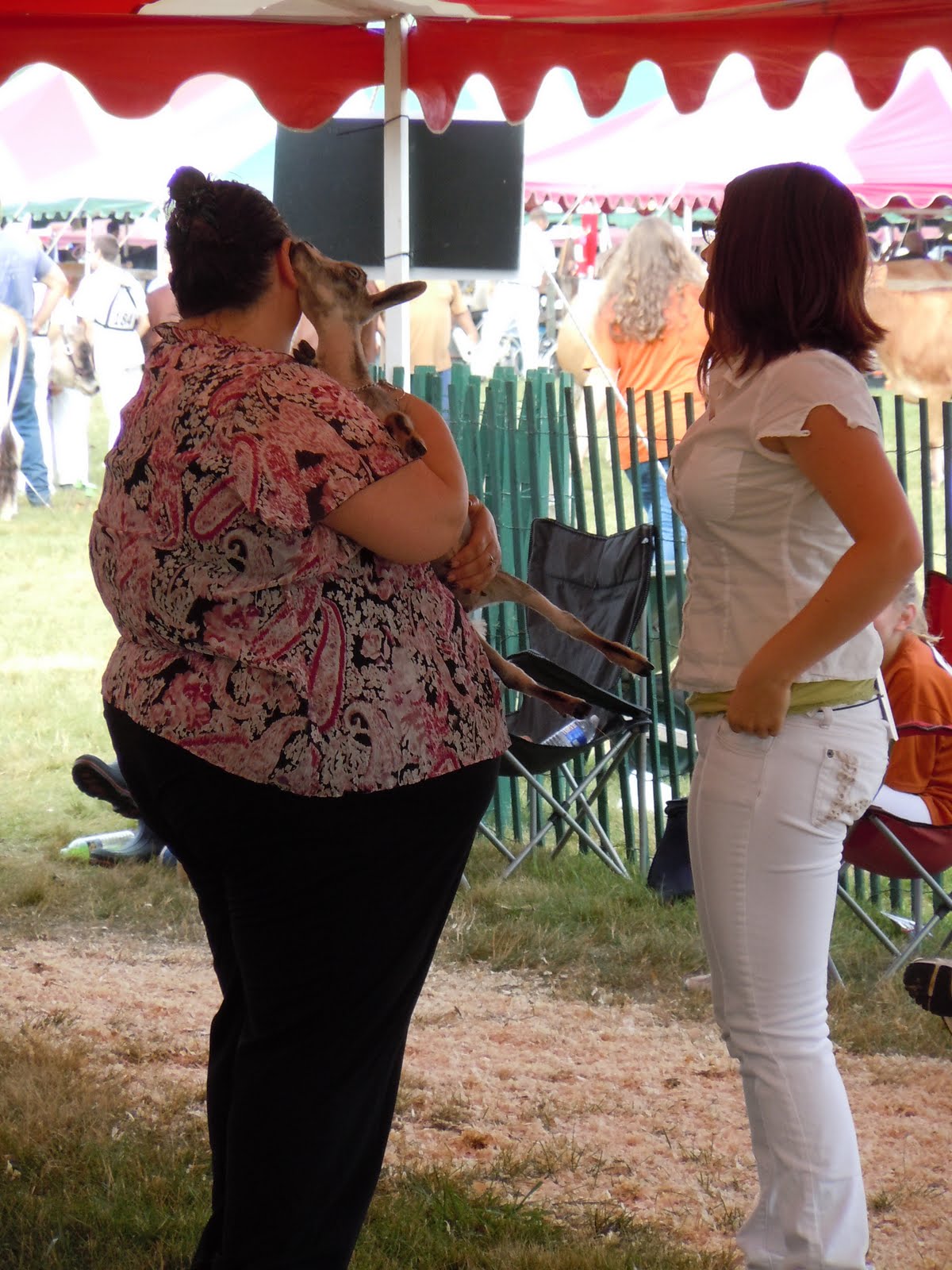
And Judge Carri Batt attempting to evaluate the animal. It was the only one in its class, so automatically received the grand champion. She (the goat, not the judge) was very feisty and would not stand still for evaluation, so Carri just picked her up. Later, on the microphone, she described why this little Nigerian was deserving of a ribbon and added "superior snugability" at the end of her comments.

I agree that this goat does, indeed, have "superior snugability."

I can't wait for next year!

Tuesday, June 29, 2010

Junior Livestock Show 2010

By: Meg Preston, Junior Livestock Show Coordinator
The countdown begins to the 63rd annual Junior Livestock Show, at the Iroquois Showgrounds, County Highway 33, which will be held on July 11-13. Now that ribbons are ordered, judges are in place, and over 300 kids and over 700 animals have entered, we are sure to have another excellent show!


This will be my 13th Jr. Show. My first year, I was thrown into the Dairy Cattle ring trying to figure out how to give out ribbons. Now I coordinate the show, running between show tents making sure everyone is settled in with no problems. This year, I will be adding my daughter into the mix; she will be showing a dairy goat.
The show kicks off Sunday evening (July 11) with a chicken barbecue by Miller’s Barbecue of Walton at 5:00 p.m., followed at 7:30 by the ice cream social. The bluegrass band Gravel Yard will begin playing at 6:30. These are both open to the public. The Barbecue is $8.00 per dinner and the ice cream social is free.
Showing begins on Monday, at 9:30 a.m. and Tuesday at 9:00 a.m. The championship awards begin at 2:30 on Tuesday.

Tuesday, September 15, 2009

Harvest Festival 2009

By: Erin Crissman, Curator

We all had a great time at Harvest Festival this year. I got some fantastic pecan pie from the Presbyterians, petted some alpacas and welcomed our 20 vendors to the grounds on Saturday and Sunday morning. Overall, more than 2200 of you enjoyed The Farmers' Museum this weekend. Hope you all had as much fun as we did! Springfield Presbyterian Church pies. Yum! Champion animals from the Junior Livestock Show 2009.

Friday, July 17, 2009

Baaaa! Live from the Sheep Tent

By: Kajsa Sabatke, Interpretive Projects Coordinator I’m writing this post amid the bleating of sheep and the smell of sawdust. Today I’m helping in the sheep tent at The Farmers’ Museum’s 62nd Annual Junior Livestock Show – this is my second year helping with ribbons in this tent. Since I grew up in a suburban area and did not participate in 4-H, I love that this is a teaching show. The first part the day for each animal is the showmanship class, where the judges evaluate participants’ animal handling skills. The youth can then use this feedback to improve their handling during the rest of the show. Participants and spectators alike can also learn more about the animals as judges explain their decisions throughout the show, and I’m already feeling more informed about sheep after a day and a half. The sheep tent also hosts my favorite Junior Livestock Show event: the Sheep Olympics. It’s similar to the agility courses that dogs run, but with less cooperative and more noisy animals. The sheep and kids all do a great job and the event is a fun way to celebrate the animals and all the hard work that has gone into preparing and showing the animals. It’s been a great two days of livestock showing. Congratulations to all our exhibitors!

Tuesday, July 14, 2009

Junior Livestock Show

By: Erin Crissman, Curator Yesterday, I had my first Junior Livestock Show experience. This event is held annually at The Farmers' Museum's auxillary location at River Road in Cooperstown. This is the 63rd year that young people from Central New York have brought their animals (sheep, cows, pigs and goats) to be shown and judged. I don't have much personal experience with livestock. I was absolutely impressed by the expertise, patience, pride and care these kids brought to the show. They were busy working away at 8am getting their animals ready. A long list of prizes are awarded today for each of the livestock categories. Prize or not, this is a wonderful experience - one I wish I had growing up.
Blog Widget by LinkWithin