Showing posts with label Getting Ready for Spring. Show all posts
Showing posts with label Getting Ready for Spring. Show all posts
Tuesday, April 14, 2009
Thanks for Helping Us Get Ready for Spring!
by: Kajsa Sabatke & Kate Betz
April 4 turned out to be a blustery, snowy day more reminiscent of winter than spring. Thanks to those enthusiastic visitors who came to the museums and joined the staff in Getting Ready for Spring at The Farmers’ Museum and discovering Hidden Treasures at the Fenimore Art Museum!
Congratulations to the winners of the prize drawings:
Gala tickets: Maureen Heffner
Family Fun package: Rudy Fedrizzi
Social Life package: Ester Winsjansen


Thursday, April 2, 2009
Hops
By: Kajsa Sabatke, Interpretive Projects Coordinator
Hops are used for flavoring and preserving beer, and Otsego County was a center of hops production during the 19th century. You can find hops in several of the fields and gardens around The Farmers’ Museum. Did you know that hops also grow in the wild and the plants can grow for 100 years? .jpg) Growing hops requires a year-round process. In the fall, our farmers add piles of compost around the plants. In the spring, they secure poles in the ground for the vines to grow around. After growing through the summer, the hops are ready for harvesting in August or September and winter is the time for drying in hop houses. We use our harvest of hops to make yeast for baking. Join us on April 4 and help the museum staff as we get ready for spring. You can learn more about hops from our farmers and help put in the hop poles for the season.
Growing hops requires a year-round process. In the fall, our farmers add piles of compost around the plants. In the spring, they secure poles in the ground for the vines to grow around. After growing through the summer, the hops are ready for harvesting in August or September and winter is the time for drying in hop houses. We use our harvest of hops to make yeast for baking. Join us on April 4 and help the museum staff as we get ready for spring. You can learn more about hops from our farmers and help put in the hop poles for the season.
Growing hops requires a year-round process. In the fall, our farmers add piles of compost around the plants. In the spring, they secure poles in the ground for the vines to grow around. After growing through the summer, the hops are ready for harvesting in August or September and winter is the time for drying in hop houses. We use our harvest of hops to make yeast for baking. Join us on April 4 and help the museum staff as we get ready for spring. You can learn more about hops from our farmers and help put in the hop poles for the season. Taugher Hop Yard. ca. Smith and Telfer Collection, New York State Historical Association.
Wednesday, April 1, 2009
Vegetables, Vegetables, Winter Vegetables
By: Gwen Miner, Supervisor of Domestic Arts
 No matter how the vegetables are stored the use of the vegetables is determined by size and condition. You all have heard, “one bad apple spoils the whole bunch,” right? The same could be said for these vegetables. In order to make the best use of them, families constantly monitored their cellar conditions. The smaller vegetables along with any that show signs of softening or rot are cooked up before the others.
 “Winter Vegetables” that were commonly grown were potatoes, carrots, onions, beets, turnips, parsnips, salsify or “Vegetable Oyster,” rutabaga or “Yellow Swede” and winter varieties of radishes. When we put everything in the cellar last fall, we had many examples of these different vegetables.
How many times as a kid were you told to eat your vegetables? I’m pretty sure children in the 19th century were told to do so too.
In nineteenth-century rural America, almost everyone had a kitchen garden and a field garden. In those gardens folks grew the vegetables that would sustain them through the following year after harvest. They grew seasonal vegetables such as lettuce, spinach and tomatoes, but also root vegetables or “Winter Vegetables.” “Winter Vegetables” is a term used to loosely designate any vegetable that grows below the soil. These vegetables were grown so frequently because they kept well throughout the winter and were easy to store either in root cellars or outside in a trench in the garden. Directions are abundant in period sources for both of these techniques. Using root cellars was often called “putting down” vegetables and leaving them in the garden was referred to as “overwintering.” Many of the methods of “putting down” vegetables work well, but each particular cellar determines the best method of storage: bins of sand if your cellar is dry or elevated wood bins if your cellar is damp. The cellar at Lippitt House is damp so we use elevated bins.
No matter how the vegetables are stored the use of the vegetables is determined by size and condition. You all have heard, “one bad apple spoils the whole bunch,” right? The same could be said for these vegetables. In order to make the best use of them, families constantly monitored their cellar conditions. The smaller vegetables along with any that show signs of softening or rot are cooked up before the others.“Winter Vegetables” that were commonly grown were potatoes, carrots, onions, beets, turnips, parsnips, salsify or “Vegetable Oyster,” rutabaga or “Yellow Swede” and winter varieties of radishes. When we put everything in the cellar last fall, we had many examples of these different vegetables. Right now, the cellar at Lippitt House is looking leaner and the vegetables that remain are not as firm or plump as they were when harvested. With careful selection, though, there will be enough vegetables left until early summer when a new season of fresh vegetables can be harvested and the cycle can begin again.
Monday, March 30, 2009
Getting Ready for Spring: Activity Sheet Now Available
 Our day of Getting Ready for Spring on April 4 is rapidly approaching! The activity sheet is now available on our website and it contains a bonus question that is only included on this special version.
We hope you’ll print out our activity sheet, check our recent blog posts for hints, and come to The Farmers’ Museum on April 4 to help us get ready for spring!
Our day of Getting Ready for Spring on April 4 is rapidly approaching! The activity sheet is now available on our website and it contains a bonus question that is only included on this special version.
We hope you’ll print out our activity sheet, check our recent blog posts for hints, and come to The Farmers’ Museum on April 4 to help us get ready for spring!
Thursday, March 26, 2009
The Printer's Devil
By: Kajsa Sabatke, Interpretive Projects Coordinator


Spring planting isn’t the only activity at the museum this season. Ted Shuart, our master printer, is also busy getting ready for the season: printing broadsides, labels, signs, and other products for the museum.
In the 1840s, a maste r printer had help from an apprentice, known as a “printer’s devil” (not a great selling point for potential applicants!). The name came from the often messy tasks an apprentice had to complete. A printer’s devil ran errands, swept floors, built fires, delivered newspapers, cleaned ink off the equipment, and put individual pieces of type back into the case after a job was completed.
Apprentices eventually completed their time and became journeymen and then master printers with their own shops. Despite a dirty start, printer’s devils eventually took on the important task of sharing news from within the community and from the outside world.
Stop by and see Ted on April 4 and help The Farmers’ Museum get ready for spring!
r printer had help from an apprentice, known as a “printer’s devil” (not a great selling point for potential applicants!). The name came from the often messy tasks an apprentice had to complete. A printer’s devil ran errands, swept floors, built fires, delivered newspapers, cleaned ink off the equipment, and put individual pieces of type back into the case after a job was completed.
Apprentices eventually completed their time and became journeymen and then master printers with their own shops. Despite a dirty start, printer’s devils eventually took on the important task of sharing news from within the community and from the outside world.
Stop by and see Ted on April 4 and help The Farmers’ Museum get ready for spring!
 r printer had help from an apprentice, known as a “printer’s devil” (not a great selling point for potential applicants!). The name came from the often messy tasks an apprentice had to complete. A printer’s devil ran errands, swept floors, built fires, delivered newspapers, cleaned ink off the equipment, and put individual pieces of type back into the case after a job was completed.
Apprentices eventually completed their time and became journeymen and then master printers with their own shops. Despite a dirty start, printer’s devils eventually took on the important task of sharing news from within the community and from the outside world.
Stop by and see Ted on April 4 and help The Farmers’ Museum get ready for spring!
r printer had help from an apprentice, known as a “printer’s devil” (not a great selling point for potential applicants!). The name came from the often messy tasks an apprentice had to complete. A printer’s devil ran errands, swept floors, built fires, delivered newspapers, cleaned ink off the equipment, and put individual pieces of type back into the case after a job was completed.
Apprentices eventually completed their time and became journeymen and then master printers with their own shops. Despite a dirty start, printer’s devils eventually took on the important task of sharing news from within the community and from the outside world.
Stop by and see Ted on April 4 and help The Farmers’ Museum get ready for spring!Tuesday, March 24, 2009
Todd's General Store
By: Kajsa Sabatke, Interpretive Projects Coordinator
 You can see this painting, Village Post Office, across the street from The Farmers’ Museum at the Fenimore Art Museum. The scene, set in a general store, shows many of the ways that stores served their communities. Store keepers stocked goods for people to buy, created credit accounts for local customers, provided post office services, and offered a place for people to meet and catch up on the latest news. In the spring, the store was stocked with seeds, tools, and supplies for planting and other springtime tasks. Genre paintings like this one depict scenes of everyday life and are valuable to us not only as art, but also as historical resources. Louis C. Jones, who served as director of NYSHA and The Farmers’ Museum from 1947-1972, said:
 Today Todd’s is a place where you can buy reproductions of historic items, including some made at the museum, and see one of the back rooms set up with original objects that represent a sampling of the goods available in 1845. If you want to learn more about buying and credit in the 1840s, join us for Getting Ready for Spring on April 4. And to discover more about the art treasures at the Fenimore Art Museum, check out Hidden Treasures. Top: The Village Post Office, 1873. Thomas Waterman Wood (1823-1903). Fenimore Art Museum, Gift of Stephen C. Clark, N0393.1955 Bottom: George Campbell, Louis Jones, and Janet MacFarlane in Todd’s General Store about 1945. *Louis C. Jones, “Genre in American Folk Art,” in Three Eyes on the Past, 167. “Genre in American Folk Art” is reprinted with permission from John C. Milley, ed., Papers on American Art (Philadelphia, Pa.: The Friends of Independence National Historic Park, 1976.)
You can see this painting, Village Post Office, across the street from The Farmers’ Museum at the Fenimore Art Museum. The scene, set in a general store, shows many of the ways that stores served their communities. Store keepers stocked goods for people to buy, created credit accounts for local customers, provided post office services, and offered a place for people to meet and catch up on the latest news. In the spring, the store was stocked with seeds, tools, and supplies for planting and other springtime tasks. Genre paintings like this one depict scenes of everyday life and are valuable to us not only as art, but also as historical resources. Louis C. Jones, who served as director of NYSHA and The Farmers’ Museum from 1947-1972, said:All social history is weak when it comes to the habits, work, dress, attitudes, play, and religious life of the lower classes in any society, and this is very true of Americans. People who work with their hands keep few diaries, write few letters, and until recently have seldom been a subject of concern to the scholar. The genre painter captures such people as would a modern photographer.*You can see Jones, along with George Campbell and Janet MacFarlane, playing checkers in Todd’s General Store.
Today Todd’s is a place where you can buy reproductions of historic items, including some made at the museum, and see one of the back rooms set up with original objects that represent a sampling of the goods available in 1845. If you want to learn more about buying and credit in the 1840s, join us for Getting Ready for Spring on April 4. And to discover more about the art treasures at the Fenimore Art Museum, check out Hidden Treasures. Top: The Village Post Office, 1873. Thomas Waterman Wood (1823-1903). Fenimore Art Museum, Gift of Stephen C. Clark, N0393.1955 Bottom: George Campbell, Louis Jones, and Janet MacFarlane in Todd’s General Store about 1945. *Louis C. Jones, “Genre in American Folk Art,” in Three Eyes on the Past, 167. “Genre in American Folk Art” is reprinted with permission from John C. Milley, ed., Papers on American Art (Philadelphia, Pa.: The Friends of Independence National Historic Park, 1976.)
Thursday, March 19, 2009
Pharmacy Preparations
By: Kajsa Sabatke, Interpretive Projects Coordinator
Patrick MacGregor,.JPG) our Pharmacy Supervisor, is making indoor and outdoor preparations for the new season in Thrall’s Pharmacy. His most recent excitement was the arrival last week of his annual batch of leeches (stay tuned for a more in-depth post on the leeches). And now that the pharmacy garden has reappeared from under the snow banks, it is time to start prepping the garden for the growing season.
our Pharmacy Supervisor, is making indoor and outdoor preparations for the new season in Thrall’s Pharmacy. His most recent excitement was the arrival last week of his annual batch of leeches (stay tuned for a more in-depth post on the leeches). And now that the pharmacy garden has reappeared from under the snow banks, it is time to start prepping the garden for the growing season.
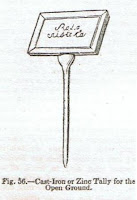 The herbs in the pharmacy garden are almost all perennials, so Patrick won’t be planting much this year. He still has plenty of work to do, though! He’ll be raking the paths, resetting and repairing the brick edges, and labeling the herbs with signs around the garden. Patrick researched garden signs in the book Gardening for Ladies and Companion to the Flower Garden and used grant funding from the New York Council
  on the Humanities to create signs that look like they did in the 1840s.
.JPG) our Pharmacy Supervisor, is making indoor and outdoor preparations for the new season in Thrall’s Pharmacy. His most recent excitement was the arrival last week of his annual batch of leeches (stay tuned for a more in-depth post on the leeches). And now that the pharmacy garden has reappeared from under the snow banks, it is time to start prepping the garden for the growing season.
our Pharmacy Supervisor, is making indoor and outdoor preparations for the new season in Thrall’s Pharmacy. His most recent excitement was the arrival last week of his annual batch of leeches (stay tuned for a more in-depth post on the leeches). And now that the pharmacy garden has reappeared from under the snow banks, it is time to start prepping the garden for the growing season.
 The herbs in the pharmacy garden are almost all perennials, so Patrick won’t be planting much this year. He still has plenty of work to do, though! He’ll be raking the paths, resetting and repairing the brick edges, and labeling the herbs with signs around the garden. Patrick researched garden signs in the book Gardening for Ladies and Companion to the Flower Garden and used grant funding from the New York Council
  on the Humanities to create signs that look like they did in the 1840s.
 left: From Gardening for Ladies and Companion to the Flower Garden, Mrs. Loudon, ed. Andrew Jackson Downing (New York: Wiley & Putnam, 1843).
Tuesday, March 17, 2009
School's Out for ... Spring?
By: Kajsa Sabatke, Interpretive Programs Coordinator
Many students today think of March as the time for spring break - a week or two away from school before they head back to class until May or June. Rural schoolchildren in the 1840s left school in March for a two-month break. Think this schedule is better than the one we have now? Not necessarily, especially for children who like their summer vacation.
 School let out in March, but it began again in May. Instead of a long vacation, students spent the spring working on their family farms and then went back to school for the summer. Farmers needed their children to help them during the busy farming seasons of spring (for planting) and fall (for harvesting). So the school year was broken into two terms. Winter term lasted from October or November until March, and summer term ran from May until sometime in late August or early September.
Now that fewer people are farmers, the school schedule does not depend on the agricultural seasons (although students in Maine still get time off for the potato harvest). Instead, students get a few breaks during the year and a long summer vacation.
*This blog post contains a clue for Getting Ready for Spring on April 4. Stay tuned for more posts on this event!
School let out in March, but it began again in May. Instead of a long vacation, students spent the spring working on their family farms and then went back to school for the summer. Farmers needed their children to help them during the busy farming seasons of spring (for planting) and fall (for harvesting). So the school year was broken into two terms. Winter term lasted from October or November until March, and summer term ran from May until sometime in late August or early September.
Now that fewer people are farmers, the school schedule does not depend on the agricultural seasons (although students in Maine still get time off for the potato harvest). Instead, students get a few breaks during the year and a long summer vacation.
*This blog post contains a clue for Getting Ready for Spring on April 4. Stay tuned for more posts on this event!
 School let out in March, but it began again in May. Instead of a long vacation, students spent the spring working on their family farms and then went back to school for the summer. Farmers needed their children to help them during the busy farming seasons of spring (for planting) and fall (for harvesting). So the school year was broken into two terms. Winter term lasted from October or November until March, and summer term ran from May until sometime in late August or early September.
Now that fewer people are farmers, the school schedule does not depend on the agricultural seasons (although students in Maine still get time off for the potato harvest). Instead, students get a few breaks during the year and a long summer vacation.
*This blog post contains a clue for Getting Ready for Spring on April 4. Stay tuned for more posts on this event!
School let out in March, but it began again in May. Instead of a long vacation, students spent the spring working on their family farms and then went back to school for the summer. Farmers needed their children to help them during the busy farming seasons of spring (for planting) and fall (for harvesting). So the school year was broken into two terms. Winter term lasted from October or November until March, and summer term ran from May until sometime in late August or early September.
Now that fewer people are farmers, the school schedule does not depend on the agricultural seasons (although students in Maine still get time off for the potato harvest). Instead, students get a few breaks during the year and a long summer vacation.
*This blog post contains a clue for Getting Ready for Spring on April 4. Stay tuned for more posts on this event!
Thursday, March 12, 2009
Getting Ready for Spring!
By: Kajsa Sabatke, Interpretive Programs Coordinator
Spring is a busy time at The Farmers’ Museum. Just like farmers in 1845, our staff is preparing for planting and the start of springtime work all over the historic village. Most families in 1845 made some portion of their living from farming, and the spring planting season depended on the contributions of everyone in the community.
Join us this year for Getting Ready for Spring on Saturday, April 4th and help us prepare for spring planting! You can pick up a list of activities and questions in the Main Barn and complete the sheet as you visit buildings around the museum. For each completed question, you will receive one ticket good for a chance to win one of several prize packages featuring tickets for admission, workshops, and special events, as well as items from our shops and from area merchants.
Each week we will feature blog posts related to the upcoming activities surrounding Getting Ready for Spring to give you a head start on the fun. One week before the event, we will also post a link to a downloadable version of the activity sheet – this special version will include a bonus question that you can answer from our blog and use to earn an extra chance to win a prize.
Stay tuned for more Getting Ready for Spring!
Subscribe to:
Posts (Atom)
