By: Erin Richardson, Curator
This year, The Farmers’ Museum, in partnership with the New York State Historical Association Research Library, will be launching a new collaborative collections database. Although still in a pilot phase, you can visit the database at collections.nysha.org. This project will allow researchers, enthusiasts, collectors and museum visitors to research objects in the Farmers’ Museum collection more thoroughly. Enough about the details of this project – more on that in a future post. What I really want to get to is a mysterious parts catalog I scanned as part of the project.
 Background: Walter A Wood was a large scale manufacturer of Agricultural Equipment located in Hoosick Falls, NY – a small town between Albany and the Vermont border. Although his business began local, it was eventually an international operation. The NYSHA library has a large and comprehensive collection of catalogs, broadsides, parts lists and circulars for Wood’s company. The Farmers' Museum also has several pieces of Wood equipment in the collection.
 In scanning one of the parts catalogs I discovered that each part had its own telegraph cipher. Perhaps I have been reading too many murder mystery novels, but my first thought about this cipher systems was related to German spies. I thought “Did the US government not want Germany to know where all of our grain was grown, so they directied these manufacturers to encode their ordering system?”

 There are a number of problems with this conspiracy-theory, not the least of which are that the codes are printed in a readily available catalog and 1906 is too early to be worrying about German spies.
My next thought was “DATA PLAN”! This may seem like a non-sequitur. However, if you have a cell phone, or have tried to upgrade your cell phone recently, you will notice that just about every phone is internet-ready and that you will have to pay for the cost of sending internet data over the cellular network to which you subscribe. It dawned on me that these telegraph cipher codes were a data cost-cutting measure for ordering your replacement parts via telegraph. Rather than sending this:
Scythe, complete, six feet
you could instruct your local telegrapher to send:
Pie.
The cipher method reduces the cost of placing the order by 75%!
Too bad pie is not included.
For a farmer who needed a replacement part during the middle of a harvest, ordering via telegraph could cut the delivery time down by days or weeks – and probably save a crop in the process.
Stay tuned for more on the Collections Access Initiative in future posts and some information about the Walter A Wood artifacts in the museum's collection.
This year, The Farmers’ Museum, in partnership with the New York State Historical Association Research Library, will be launching a new collaborative collections database. Although still in a pilot phase, you can visit the database at collections.nysha.org. This project will allow researchers, enthusiasts, collectors and museum visitors to research objects in the Farmers’ Museum collection more thoroughly. Enough about the details of this project – more on that in a future post. What I really want to get to is a mysterious parts catalog I scanned as part of the project.


Here's a detail view:
(click to enlarge)

My next thought was “DATA PLAN”! This may seem like a non-sequitur. However, if you have a cell phone, or have tried to upgrade your cell phone recently, you will notice that just about every phone is internet-ready and that you will have to pay for the cost of sending internet data over the cellular network to which you subscribe. It dawned on me that these telegraph cipher codes were a data cost-cutting measure for ordering your replacement parts via telegraph. Rather than sending this:
Scythe, complete, six feet
you could instruct your local telegrapher to send:
Pie.
The cipher method reduces the cost of placing the order by 75%!
Too bad pie is not included.
For a farmer who needed a replacement part during the middle of a harvest, ordering via telegraph could cut the delivery time down by days or weeks – and probably save a crop in the process.
Stay tuned for more on the Collections Access Initiative in future posts and some information about the Walter A Wood artifacts in the museum's collection.


 I was surprised to learn that it was donated in 1979 – much later than I had originally thought. It has a wonderful story behind it as well. The calf was born in 1875 on M. John
  For a few years, the two headed calf was part of the Museum of Curiosities exhibit at The Farmers’ Museum – along with the Cardiff Giant, of course!
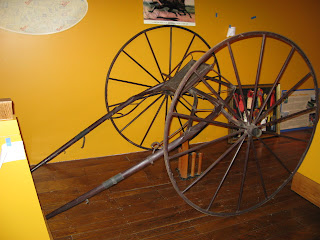
  The sulky in this exhibition is a great way to talk about horses in Central New York. Horses weren’t just for work, they were (and still are) for recreation. This sulky was probably used for rural racing and possibly even for quick one-passenger transportation. It complements the other large objects in the horse section – a one horse power tread that harnessed a horse’s power to operate threshers and a sleigh – essential for winter transportation.
 Hope you’ll come to check out my equipment assembly skills – and join Lulu and Max on their quest across the state.
 On May 15, 1948, the Giant arrived at The Farmers’ Museum where he was “laid to rest,” as it were, by a group of workers. The exhibit was opened to the public four days later and crowds began to arrive to once again gawk at the “stupendous stone statue.”
All was not wine and roses for the Giant, however. Less than a year after his arrival, the Giant was at the center of new drama when a man by the name of Michael Fitzmaurice sued the museum, stating that his grandfather had created the Cardiff Giant and had loaned him to P.T. Barnum. (Those of you who have been to the museum and seen our most recent display will know that this was, of course, a false claim—P.T. Barnum never owned THE Cardiff Giant, but had created a fake of a fake that he exhibited at the same time that the Giant enjoyed its greatest success).
Three years after his arrival, the Giant was done with life in a pit. He determined that life above ground had many more benefits. In 1951, he was moved to an above ground display where he remained for the next fourteen years until, in 1965, he moved to even fancier digs in a covered enclosure at the end of our Main Barn.
Again ready for a change of scenery, the Giant moved in 1984 to a new exhibit in what is now the Louis C. Jones Center called the “Museum of Wonders.” There, he joined the ranks of some of the most eclectic items from the collections of museums across New York State including a two-headed calf, dinosaur tracks, and relics of the American Revolution. This exhibit was meant to show museum visitors what the very earliest museums—such as the
On May 15, 1948, the Giant arrived at The Farmers’ Museum where he was “laid to rest,” as it were, by a group of workers. The exhibit was opened to the public four days later and crowds began to arrive to once again gawk at the “stupendous stone statue.”
All was not wine and roses for the Giant, however. Less than a year after his arrival, the Giant was at the center of new drama when a man by the name of Michael Fitzmaurice sued the museum, stating that his grandfather had created the Cardiff Giant and had loaned him to P.T. Barnum. (Those of you who have been to the museum and seen our most recent display will know that this was, of course, a false claim—P.T. Barnum never owned THE Cardiff Giant, but had created a fake of a fake that he exhibited at the same time that the Giant enjoyed its greatest success).
Three years after his arrival, the Giant was done with life in a pit. He determined that life above ground had many more benefits. In 1951, he was moved to an above ground display where he remained for the next fourteen years until, in 1965, he moved to even fancier digs in a covered enclosure at the end of our Main Barn.
Again ready for a change of scenery, the Giant moved in 1984 to a new exhibit in what is now the Louis C. Jones Center called the “Museum of Wonders.” There, he joined the ranks of some of the most eclectic items from the collections of museums across New York State including a two-headed calf, dinosaur tracks, and relics of the American Revolution. This exhibit was meant to show museum visitors what the very earliest museums—such as the  Though he enjoyed the company, the Giant eventually tired of sharing the spotlight with the other objects and again sought a relocation—this time to nearly the same spot that he had occupied on his arrival in 1948. He was exhibited in a tent that was meant to recreate the manner in which nineteenth-century spectators would have come upon him.
In 2003, Giant and tent were moved to become a part of the museum’s new
Though he enjoyed the company, the Giant eventually tired of sharing the spotlight with the other objects and again sought a relocation—this time to nearly the same spot that he had occupied on his arrival in 1948. He was exhibited in a tent that was meant to recreate the manner in which nineteenth-century spectators would have come upon him.
In 2003, Giant and tent were moved to become a part of the museum’s new  Even the most stoic of giants eventually becomes antsy and yearns to roam free. After 58 years of living within the museum’s walls, the Cardiff Giant was allowed off the grounds for a special treat—a central part of the
  Since his time in the sun, the Giant has recently retired to a quieter location at the entrance to our Main Barn. Make sure to pay him a visit when we open the doors for his 61st season at the museum on April 1st.


