by: Garet Livermore, Vice President for Education
THANKSGIVING DAY.--When shall it be? The last Thursday in November falls on the 29th. We petition each and all the State governors to appoint that day for our national rejoicing. Then all the land will be glad together, and union among the people would be a sure pledge of heart-thankfulness to God, who has given to us, as a nation, such wonderful prosperity, such universal blessings. -- Sarah J. Hale, Editor, Godey’s Lady’s Book, October 1855.

Fall thanksgiving celebrations have been a part the American experience since colonial days. The celebration at Plymouth Plantation by the Pilgrims in 1621 is only the most famous example. Celebrating at harvest time with a feast and games was a common practice in all of the colonies, including New York and Virginia. Each location marked the successful harvest with its own traditional foods and activities. It was not until a public relations campaign spearheaded by Sarah J. Hale, the editor of Godey’s Ladies Book, in the middle of the 19th century that the holiday became a national event. The date was first fixed as the final Thursday in November by the proclamation of President Abraham Lincoln in 1863 and later adjusted to the fourth Thursday in November in a law signed by Franklin D. Roosevelt in 1941. Apparently, Roosevelt felt that in the country would benefit from the extra week of Christmas shopping in those years when November has five Thursdays.

The Turkey as National Dish
The centerpiece of most Thanksgiving meals, the turkey, has an interesting history of its own. Although many people know the story of Ben Franklin’s proposal to make the bird our national symbol, fewer know why it is the almost universal choice for our Thanksgiving meals. When early settlers came to Massachusetts, they were pleased to find fish and game in abundance. They were particularly fond of the bird they called the “Turkey Fowl” because of the belief that it was related to the guinea fowl then being imported to Europe from the Middle East.
Initially, the birds were so numerous that they were a reliable food source for early settlers. Edward Winslow, a Pilgrim leader, described hunting the birds for the first Thanksgiving meal: “Our harvest being gotten in, our governor sent four men on fowling, that so we might after a special manner rejoice together after we had gathered the fruits of our labor. They four in one day killed as much fowl as, with a little help beside, served the company almost a week.” With this kind of unsustainable hunting the birds quickly became scarce, and wild turkeys almost disappeared from New England in the 18th century.


Just like today, the demand for turkeys was highly seasonal in the 19th century. Farmers who raised the birds had to drive them to market for the profitable holiday season. “Driving” turkeys in the 19th century consisted of getting the whole flock to walk, sometimes more than a hundred miles, to market under their own power. The flock was led by a wagon filled with grain that a boy sprinkled in front of the group and it was followed by men with long “switches” or sticks that could be used to poke and prod reluctant turkeys along the way. The process had several challenges, including birds’ instinct to roost in trees, on roofs and in the rafters of covered bridges that they encountered. “Turkey trots” were often held up for days while the drovers climbed in trees and on buildings, poking at the birds to get them down on the ground and walking to market again.
Thanksgiving at The Farmers’ Museum
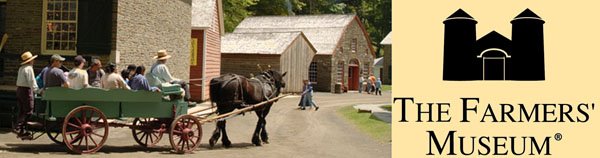
The Farmers' Museum will reopen its doors on the Friday and Saturday following Thanksgiving to offer visitors a glimpse of how Thanksgiving was celebrated in 1845. Visitors will get a chance to see a turkey drive and help the Farmers move our turkeys to market across the museum grounds. You will see our staff prepare a traditional Thanksgiving meal at Lippitt farmhouse and watch the blacksmith forge trivets and fireplace tools. At the Middlefield Printing Shop you can print a traditional Thanksgiving recipe to take home for your own use. Come join the fun and explore the museum!


 Cranberry salad, cranberry relish, applesauce and yams, oyster stew and sweet potatoes with marshmallows are also favorites. I can personally attest to the delicious addition of marshmallows to sweet potatoes or squash as someone who was banned from marshmallow duty after my zealous quantity of marshmallows overflowed the squash and covered the oven racks.
My marshmallow incident, which happened when I was about 11, is a story my family still loves to tell – or at least tease me about – every year. Another favorite Thanksgiving tale comes from the first time I hosted dinner, in an apartment near some railroad tracks. The rumbling of the trains helped the oven unplug itself sometime between the turkey going in and about 30 minute later when I realized that the turkey wasn’t cooking. Luckily, the problem was easily remedied after we pulled the oven away from the wall and plugged it back in.
Do you have any favorite Thanksgiving stories, dishes, or recipes? Please share them! And stop by to visit us on Friday and Saturday.
Cranberry salad, cranberry relish, applesauce and yams, oyster stew and sweet potatoes with marshmallows are also favorites. I can personally attest to the delicious addition of marshmallows to sweet potatoes or squash as someone who was banned from marshmallow duty after my zealous quantity of marshmallows overflowed the squash and covered the oven racks.
My marshmallow incident, which happened when I was about 11, is a story my family still loves to tell – or at least tease me about – every year. Another favorite Thanksgiving tale comes from the first time I hosted dinner, in an apartment near some railroad tracks. The rumbling of the trains helped the oven unplug itself sometime between the turkey going in and about 30 minute later when I realized that the turkey wasn’t cooking. Luckily, the problem was easily remedied after we pulled the oven away from the wall and plugged it back in.
Do you have any favorite Thanksgiving stories, dishes, or recipes? Please share them! And stop by to visit us on Friday and Saturday.


